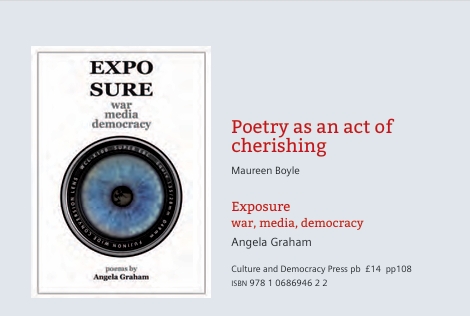
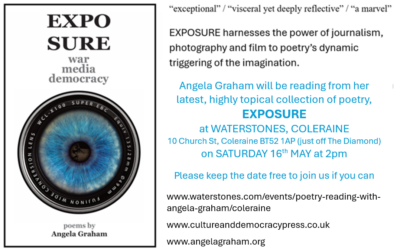
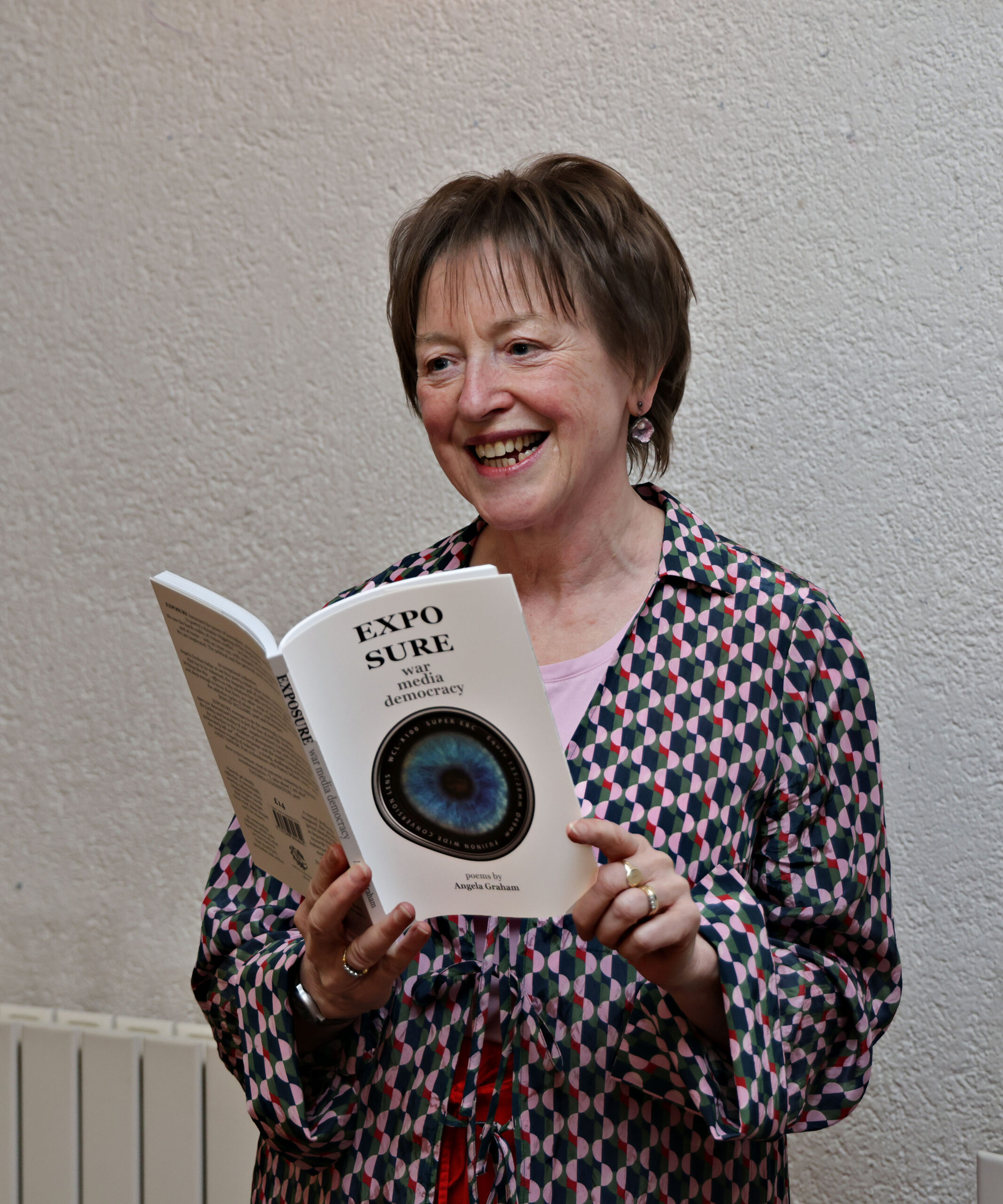
My latest book is EXPOSURE: war, media, democracy 74 poems, from culture & democracy press, due in February 2026. It brings together my journalistic and literary experience.
These poems are prompted by photo-journalism, documentary film, radio, tv and social media reports of war – the Russian invasion of Ukraine and the Israel/Gaza war as well as conflict at home.
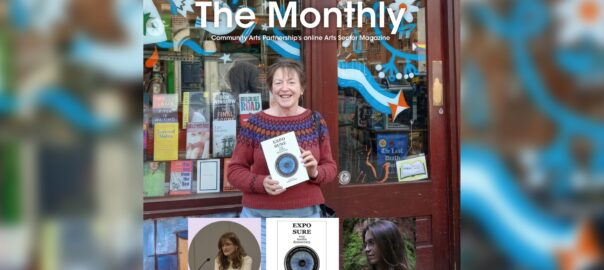
In the latest issue of The Monthly | CAP Arts Centre you’ll find two pieces about Exposure and a link to a video interview with me by Taz Rahman
Through LaVA – Literature and the Verbal Arts – Community Arts Partnership organises arts facilitation projects in schools and communities in Northern Ireland.
Two of those projects are the Poetry in Motion projects (Schools and Community) which place working poets into short residential placements in schools and communities.
Supported by the Arts Council of Northern Ireland, the Arts Council Lottery and Belfast City Council, these successful programmes are now in their fourteenth year.
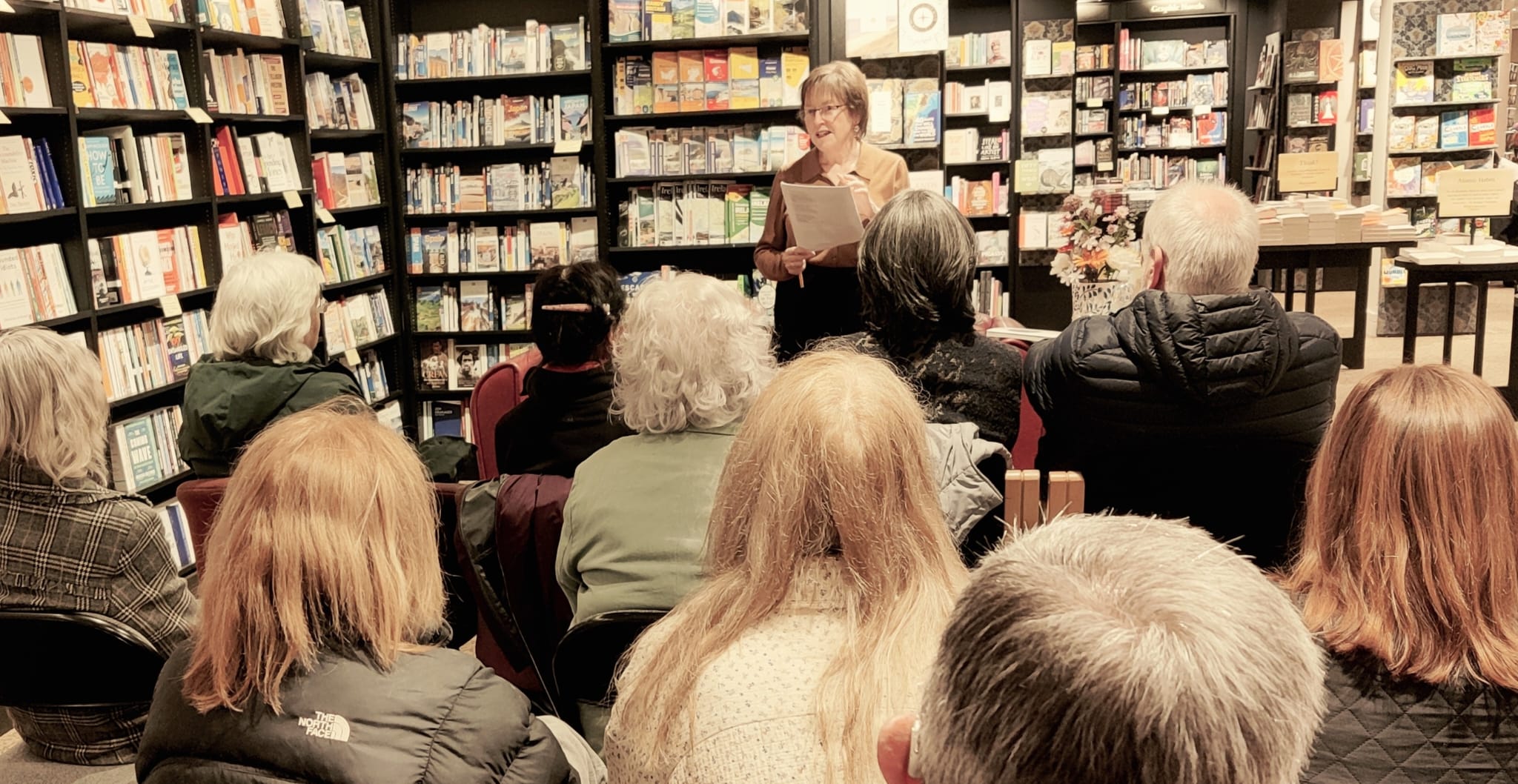
It’s a week ago that ‘EXPOSURE’ launched in Cardiff. I am writing about it only now because it has been an exceptionally busy time.
Jon Gower, pictured top left above, was a wonderful interviewer and host. He made it very easy for me to talk about the book, and with such a receptive audience it was a pleasure to read poems from the collection. I felt a strong sense of engagement with the audience.
Publisher, Phil Cope, of Culture & Democracy press, has been enormously generous in the time and attention he has devoted to this book. His faith in me has moved mountains.
I received the beautiful yellow roses below from one of the Ukrainians present.
And I’m grateful to the many people who braved a wet night on a rugby weekend, heavy traffic and the resulting atrocious parking conditions to help launch this book!
I feel immensely privileged to have this support. Thank you.
I came to Wales for the first time in 1976. Since then, I’ve noted or been involved with, a variety of initiatives around the connections between Wales and Ireland. Academic scrutinies, the grass-roots engagement of informed enthusiasts, and the transmission of Irish culture through family networks and the arts and sport in particular, have all raised the profile of Irish experience in Wales.
Inter-governmental links do much to foster good relationships. In October 2021, the re-establishment of the Irish Consulate in Wales heralded a new period of increased official engagement, as in the Ireland Wales Forum, hosted by the Welsh Government. In 2025 the Ireland-Wales Shared Statement 2030 took ahead earlier progress on how the two countries ‘can work together to deliver real benefits for our peoples and communities.’
Nonetheless an event held in Cardiff on 11th February has been a particularly significant development.
Very appropriately, an annual celebration of Saint Brigid, Ireland’s female patron saint, was combined with the official launch of Irish Women’s Network Wales at the Irish Consulate in Cardiff.
Fiadhna McEvoy (centre) entertained us with lively music
This Network brings something new to the Irish/Welsh nexus because it is wide enough to encompass all interests. Since it isn’t based on any sectional focus it enjoys unprecedented scope to nurture fresh connections. The results will be novel and dynamic.
Denise McQuade, Consul General of Ireland in Cardiff, said, “Having spoken to Irish women who have made Wales their home, we understand the importance of connection with fellow Irish women and celebrating our Irish heritage. Having initiated the idea in 2025, it was a pleasure to support and work with this committed group of women in fulfilling their goal. We look forward to seeing how their journey continues”.
The Consul General of Ireland in Wales, Denise McQuade, second from left; the Vice Consul, Michelle Ryan on her right. Committee members, from left, Úna Rice, Co-chairs, Pauline Lomax and Fiadhna McEvoy; Cliona O’Neill, Margaret Keenan and June Ryan
Getting to know one another is a key first step. At the event I met women who had been in Wales only a matter of weeks. For them the occasion was an invaluable opportunity to make connections. For some of those long-established in the country there was the pleasure of comparing experiences. And the sheer pleasure of talking with people who ‘know where you come from’ should never be under-estimated!
Whether you’re first- or fifth-generation Irish there will be a welcome. A broad range of events is planned and suggestions are welcome.
And the next event is a St Patrick’s Day evening meet-up in O’Neill’s bar, St Mary Street, Cardiff. Details from irishwomensnetworkwales@gmail.com
I read a poem about St Brigid and poems from my new collection ‘Exposure’
Poetry review: Exposure by Angela Graham 01 Feb 2026 Culture and Democracy Press
CJ Wagstaff
Angela Graham demonstrates that the language of documentary is her bread and butter in this sensitive and assured riff on photopoetry from Culture and Democracy Press. Across the collection, Graham positions poetry as a form of creative record-keeping as she seeks to sit unflinchingly with global conflict.
The first section, titled ‘Soldiers and Civilians’, features poems responding to contemporary war photography ranging from genocide in Gaza to Russia’s invasion of Ukraine. Here, Graham stretches her ekphrastic muscles, producing poems which are rich with restraint and physical presence. Rather than grand moral statements, she opts for powerfully understated description, as she responds, for example, to a photograph of a deceased soldier:
‘patches of camouflage
emerging like moss
in a parody of Spring’ (‘Weather’)
Graham’s specificity is what makes this work exciting. She zooms in on each scene to isolate its finer details: the steel finish of an armoured vehicle, or the sun setting behind wholesale sheds in Ukraine. Meaning is not imposed but emerges instead through the poet’s careful attention to her subjects.
Notably, the source photographs themselves are absent from the collection, leaving the reader to rely entirely on Graham’s interpretations. Some of these are undeniably graphic. Visceral moments such as a soldier ‘rotting inside his uniform’ (‘Photograph of a Dead Russian Soldier’) confront the reader with violence that is difficult to sit with. This will not be to everyone’s taste, but it stands staunchly as a testament to the role of poetry as witness. These are poems that insist on the responsibility of the artist not to turn away, even when the act of attention feels uncomfortable.
Interspersed throughout the collection are also poems that turn their gaze inward, becoming self-reflexive meditations on the photographic process. Juxtaposed with the ekphrastic work, these pieces are as unsettling as they are compelling, interrogating the relationships between subject, lens, and viewer. In ‘An Act of Mercy?’, Graham observes how ‘a perfect fan of emptied winter branches / by the top left corner / gives a sense of distance and proportion’. What might read as apathy here is a gambit in a collection that otherwise sings with compassion.
As a combined work, this feels, above all, radically human. Graham’s moral clarity is patently rooted in lived experience, having grown up during the Troubles in Northern Ireland. This is a history which has clearly shaped her ethical framework. She reflects:
‘Born into Ulster
my whole life I’ve had to think about revenge:
what was taken; what should be taken back.’
This background informs a keen sense of justice, evident in her deeply empathetic portraits.
This empathy is particularly vivid in a sequence of six persona poems spanning pages 26 to 34, in a section titled ‘I Imagine Being’. These, for me, are where Graham’s writing is strongest, most imaginative, most complete.
In the first poem of this sequence, she inhabits the perspective of unit commander Vovan as he returns to his mother after active duty, marking what is arguably the most powerful moment in the collection. Graham contrives an intimate proximity to these narrators, imagining gestures of care and domesticity in an otherwise hostile world – ‘Mama cried out, My golden boy! My little fish!’ – effective reminders of the real lives and stories continuing on despite it all.
This is a meticulously structured collection, with poems divided into clear categories and sub-categories. Its second half, ‘Citizens and Politicians’, shifts toward a more abstract, idea-driven mode. Here, Graham’s personal politics are more overt as she addresses world leaders and offers observations on the global sociopolitical climate. But while this section contains moments of sharp insight, it is admittedly less consistent than the earlier work.
Graham is at her strongest when dealing with the concrete, drawing significance from lived or closely imagined experience rather than reaching outward. This is demonstrated in ‘Trump, Vance, 28 February 2025’ with a well-meaning reference to lynching that feels slightly jarring in the broader context of the collection. The best moments remain grounded in tactile detail: the advance and retreat of snow in Ukraine; a climbing frame-turned-memorial piled with teddy bears and flowers. Images that leave space for the reader to locate their own response to the work.
Overall, this is an ambitious collection marked by moments of profound clarity and beauty. Graham’s commitment to noticing, alongside her disciplined formal approach, results in a collection that is rigorous, innovative and thoughtful. While ever-so-slightly uneven in places, EXPOSURE offers a sustained and serious engagement with the practice of looking, culminating in a worthwhile and timely read in 2026.
I’m grateful to start 2026 as Poet of the Month for January in The Lonely Crowd journal .
Three poems will be published from my collection ‘Exposure: war, media, democracy’ due in February from culture & democracy press.
‘Exposure’ is in two parts. The first ‘Soldiers and Civilians’ looks at the Russian invasion of Ukraine and the Gaza/Israel conflict; the second, ‘Citizens and Politicians’ looks at conflicts in democracy and politics.
The Lonely Crowd has chosen ‘A Plan for the Development of Gaza’. My piece about writing the three poems will follow later this month.
As part of Belfast International Arts Festival the Linen Hall Library launched its Fragments of Scotch Poetry project, a creative encounter between contemporary poets in Scots, Ulster-Scots, Scots Gaelic and English and featuring the Scots Makar (National Poet of Scotland), Pàdraig MacAoidh and former Scots Makar, Kathleen Jamie. (She will be featured in a Linen Hall event on 4th November Kathleen Jamie in conversation with Chris Agee – The Linen Hall, Belfast).
In 1786 The Belfast Newsletter published extracts from three poems under the heading ‘Fragments of Scotch Poetry’. The un-named author was Robert Burns.
I welcome any opportunity to broaden my awareness of my literary heritage and the context in which I write. I have always been aware of the Irish Gaelic tradition, mainly through translation, and the fertile reaches of Irish writing in English. The influence of Scotland has been part of my writing background, and come more to the fore since I have been writing in Ulster-Scots.
The Gibson Collection contains much work of a Scottish sensibility in English. Engaging with it is like opening a window wider, extending the view, breathing more deeply. Since I went to live in Wales as an adult, Welsh writing, in Welsh and English, has been a great gift to me. Scotland has been a part of my atmosphere since birth, I could say, and I welcome any chance to get to know its writing better.
Published mid-October: Issue 499 of ‘Fortnight’, Northern Ireland’ s journal of politics and culture. I guest-edited the Arts section and it was such a pleasure to work with these writers. View the issue online here
On October 11th I was one of the winning writers taking part in the Soundwaves Performance Trophy competition in Portrush Town Hall as part of the town’s Swell Festival. A lovely evening, so warmly and efficiently compered by Mary Farrell. The winner of the Poetry Performance Trophy was Gary Devenney. The Poetry Prize Winner, Colin Dardis. The standard in poetry and prose was high. So much verve and imagination and so entertaining.
On 22nd October the Fragments of Scotch poetry Jukebox project was launched at the iconic Linen Hall Library, Belfast. I am one of 10 poets commissioned to write a poem in response to a poem from the Library’s Gibson Collection. The jukebox is sited in the Library. You can hear each poet read a poem from the Collection and t a poem written as their own response to the Collection, along with the poem texts, with readings by the poet.
On 20th October I delivered the final version of my next poetry collection, ‘Exposure’ to Culture & Democracy Press. It will be published in February 2026.
A single post for these four months, partly because my right arm has been somewhat out of action for a while so this is a rather rough and ready post . Photo shows Anne McMaster and me with crew on Double Band Films shoot.
Nawr magazine published my Welsh-language poem, ‘Newid’ and an article by me about writing about The End of the World in Ulster-Scots, Welsh and English, https://nawrmag.wordpress.com/blog/
The documentary Out Of The Silence, presented by Anne McMaster was screened on 16th February on BBC One Northern Ireland. I featured in this alongside other female authors from NI. View here https://www.bbc.co.uk/programmes/m00281kw
The Linen Hall is an historic library in Belfast, which holds the largest collection of Robert Burns material, outside of Scotland in The Gibson Collection : https://linenhall.com/gibson-collection-samantha-mccombe/. Fragments of Scotch Poetry is the second curation of commissioned poems for the Poetry Jukebox and follows The Lexicon; a curation in English, Irish, French and Breton. I’m one of ten contemporary poets commissioned to write a new poem, inspired directly or indirectly by Burns. These new poems will feature on the Poetry Jukebox at the Linen Hall and at least two other venues as well as online.
I was allocated Burns’s Address To A Haggis as my starting-point. Having read widely in the Gibson collection I was very struck by Burns’s political commitment and by the facility with verse forms which all the poets demonstrate. So I’ve written a poem about Trump and Netanyahu which draws on both these.
Issue 14 of Offline Journal https://www.offline.wales/ which deals with contemporary photography, commissioned Phil Cope to do one of its separately published long-form essays on the subject of photo-poetry. Two poems of mine which are based on family photographs are featured.
I am delivering four sessions for Ballycastle Writers Group on prose and poetry.