All posts by angela

‘radically human’ Exposure reviewed in Nation Cymru

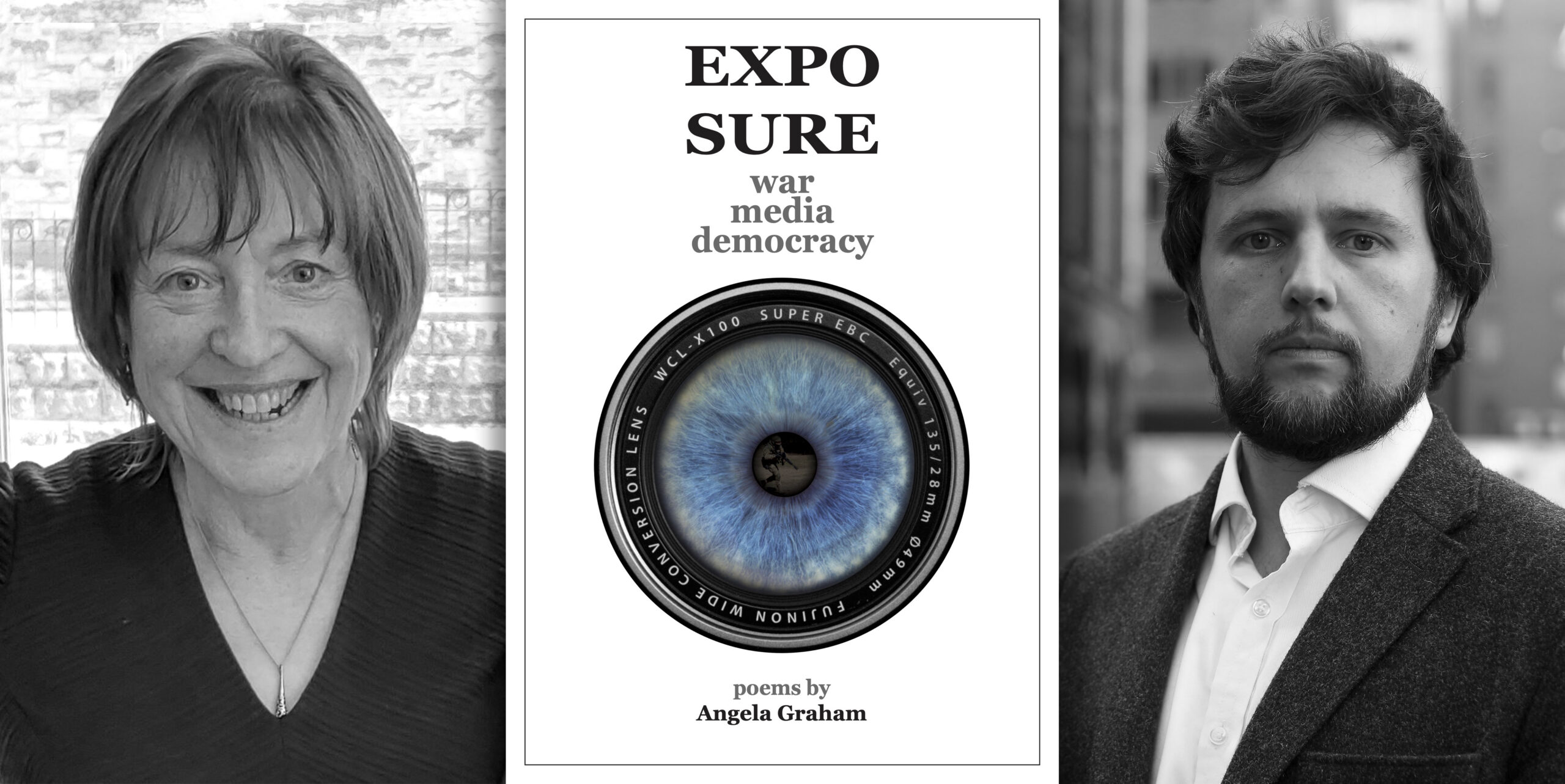
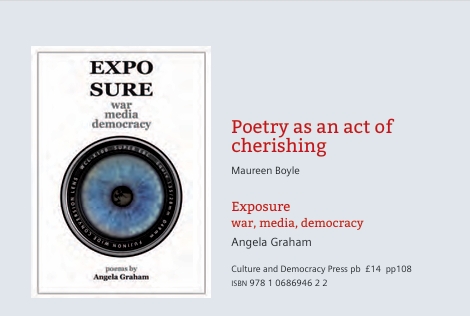
Poetry review: Exposure by Angela Graham 01 Feb 2026  Culture and Democracy Press

CJ Wagstaff

Angela Graham demonstrates that the language of documentary is her bread and butter in this sensitive and assured riff on photopoetry from Culture and Democracy Press. Across the collection, Graham positions poetry as a form of creative record-keeping as she seeks to sit unflinchingly with global conflict.

The first section, titled ‘Soldiers and Civilians’, features poems responding to contemporary war photography ranging from genocide in Gaza to Russia’s invasion of Ukraine. Here, Graham stretches her ekphrastic muscles, producing poems which are rich with restraint and physical presence. Rather than grand moral statements, she opts for powerfully understated description, as she responds, for example, to a photograph of a deceased soldier: 

‘patches of camouflage 

emerging like moss  

in a parody of Spring’ (‘Weather’)

Graham’s specificity is what makes this work exciting. She zooms in on each scene to isolate its finer details: the steel finish of an armoured vehicle, or the sun setting behind wholesale sheds in Ukraine. Meaning is not imposed but emerges instead through the poet’s careful attention to her subjects.

Notably, the source photographs themselves are absent from the collection, leaving the reader to rely entirely on Graham’s interpretations. Some of these are undeniably graphic. Visceral moments such as a soldier ‘rotting inside his uniform’ (‘Photograph of a Dead Russian Soldier’) confront the reader with violence that is difficult to sit with. This will not be to everyone’s taste, but it stands staunchly as a testament to the role of poetry as witness. These are poems that insist on the responsibility of the artist not to turn away, even when the act of attention feels uncomfortable.

Interspersed throughout the collection are also poems that turn their gaze inward, becoming self-reflexive meditations on the photographic process. Juxtaposed with the ekphrastic work, these pieces are as unsettling as they are compelling, interrogating the relationships between subject, lens, and viewer. In ‘An Act of Mercy?’, Graham observes how ‘a perfect fan of emptied winter branches / by the top left corner / gives a sense of distance and proportion’. What might read as apathy here is a gambit in a collection that otherwise sings with compassion. 

As a combined work, this feels, above all, radically human. Graham’s moral clarity is patently rooted in lived experience, having grown up during the Troubles in Northern Ireland. This is a history which has clearly shaped her ethical framework. She reflects:

‘Born into Ulster 

my whole life I’ve had to think about revenge: 

what was taken; what should be taken back.’ 

This background informs a keen sense of justice, evident in her deeply empathetic portraits.

This empathy is particularly vivid in a sequence of six persona poems spanning pages 26 to 34, in a section titled ‘I Imagine Being’. These, for me, are where Graham’s writing is strongest, most imaginative, most complete.

In the first poem of this sequence, she inhabits the perspective of unit commander Vovan as he returns to his mother after active duty, marking what is arguably the most powerful moment in the collection. Graham contrives an intimate proximity to these narrators, imagining gestures of care and domesticity in an otherwise hostile world – ‘Mama cried out, My golden boy! My little fish!’ – effective reminders of the real lives and stories continuing on despite it all.

This is a meticulously structured collection, with poems divided into clear categories and sub-categories. Its second half, ‘Citizens and Politicians’, shifts toward a more abstract, idea-driven mode. Here, Graham’s personal politics are more overt as she addresses world leaders and offers observations on the global sociopolitical climate. But while this section contains moments of sharp insight, it is admittedly less consistent than the earlier work.

Graham is at her strongest when dealing with the concrete, drawing significance from lived or closely imagined experience rather than reaching outward. This is demonstrated in ‘Trump, Vance, 28 February 2025’ with a well-meaning reference to lynching that feels slightly jarring in the broader context of the collection. The best moments remain grounded in tactile detail: the advance and retreat of snow in Ukraine; a climbing frame-turned-memorial piled with teddy bears and flowers. Images that leave space for the reader to locate their own response to the work.

Overall, this is an ambitious collection marked by moments of profound clarity and beauty. Graham’s commitment to noticing, alongside her disciplined formal approach, results in a collection that is rigorous, innovative and thoughtful. While ever-so-slightly uneven in places, EXPOSURE offers a sustained and serious engagement with the practice of looking, culminating in a worthwhile and timely read in 2026.

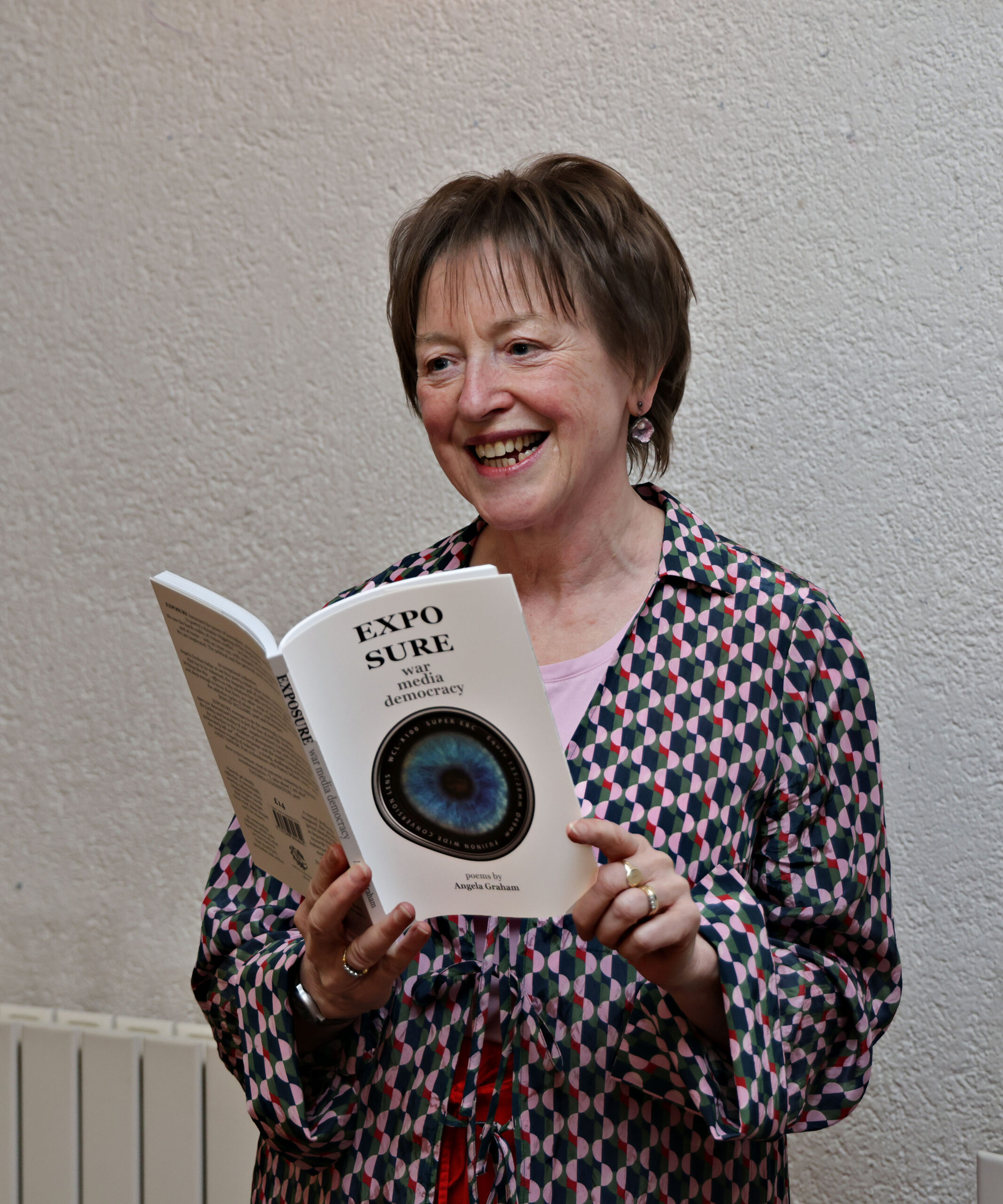
Angela Graham’s EXPOSURE is published by Culture and Democracy Press price £14

Poetry review: Exposure by Angela Graham

Praise for STAR

Buy now from gwales website or Amazon or via any bookshop

32 poems, with 15 illustrations (copyright Martin Erspamer), from Culture And Democracy Press, 2024. Chosen by The Books Council of Wales as Book of the Month December 2024.

‘It takes a real poet to make those of us jaded by Christmas re-imagine the season. Angela Graham performs the feat of translating the festival into an urgent challenge, fraught with our contemporary problems and yet full of joy.’ Gwyneth Lewis, inaugural National Poet of Wales.

‘a wonderful gathering of poems … such a lightness of touch with the old tropes, so much music and energetic imagination at work, so many new notes sounded. Not a line is predictable or a thought expected …’ Damian Smyth, poet and Head of Literature and Drama, Arts Council of Northern Ireland.

‘Read Star: Poems for the Christmas Season every year to remember the deeper values beyond the commercialism …’ Zoe Brigley, poet and editor of Poetry Wales.

Exposure

Coming soon!

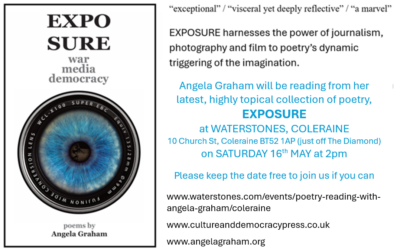
My latest book is EXPOSURE: war, media, democracy 74 poems, from culture & democracy press, due in February 2026. It brings together my journalistic and literary experience.

These poems are prompted by photo-journalism,  documentary film, radio, tv and social media reports of war – the Russian invasion of Ukraine and the Israel/Gaza war as well as conflict at home.

Poet of the Month -The Lonely Crowd

I’m grateful to start 2026 as Poet of the Month for January in The Lonely Crowd journal .

Three poems will be published from my collection ‘Exposure: war, media, democracy’ due in February from culture & democracy press.

‘Exposure’ is in two parts. The first ‘Soldiers and Civilians’ looks at the Russian invasion of Ukraine and the Gaza/Israel conflict; the second, ‘Citizens and Politicians’ looks at conflicts in democracy and politics.

The Lonely Crowd has chosen ‘A Plan for the Development of Gaza’. My piece about writing the three poems will follow later this month.

Languages in conversation: Fragments of Scotch Poetry project

As part of Belfast International Arts Festival the Linen Hall Library launched its Fragments of Scotch Poetry project, a creative encounter between contemporary poets in Scots, Ulster-Scots, Scots Gaelic and English and featuring the Scots Makar (National Poet of Scotland), Pàdraig MacAoidh and former Scots Makar, Kathleen Jamie. (She will be featured in a Linen Hall event on 4th November Kathleen Jamie in conversation with Chris Agee – The Linen Hall, Belfast).

I was one of 10 poets commissioned to respond to a poem from the Library’s Gibson Collection of Burns material and works by other poets of Scotland. ‘Fragments of Scotch Poetry’: the influences of Robert Burns – The Linen Hall, Belfast Via this link you can see some of the major works in the collection. A fascinating resource.

In 1786 The Belfast Newsletter published extracts from three poems under the heading ‘Fragments of Scotch Poetry’. The un-named author was Robert Burns.

I welcome any opportunity to broaden my awareness of my literary heritage and the context in which I write. I have always been aware of the Irish Gaelic tradition, mainly through translation, and the fertile reaches of Irish writing in English. The influence of Scotland has been part of my writing background, and come more to the fore since I have been writing in Ulster-Scots.

The Gibson Collection contains much work of a Scottish sensibility in English. Engaging with it is like opening a window wider, extending the view, breathing more deeply. Since I went to live in Wales as an adult, Welsh writing, in Welsh and English, has been a great gift to me. Scotland has been a part of my atmosphere since birth, I could say, and I welcome any chance to get to know its writing better.

Continue reading Languages in conversation: Fragments of Scotch Poetry project

September and October

It has been a very busy time. Headlines!

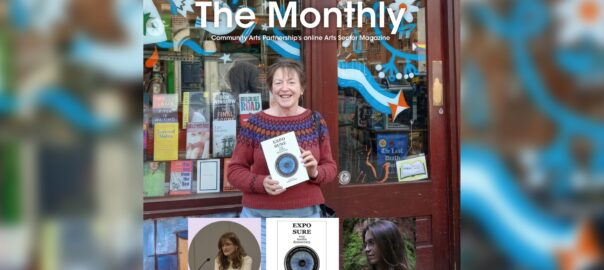
Published 23rd October Angela Graham on participating in the Community Arts Partnership ‘Poetry In Motion’ Project and the Seamus Heaney Award for New Writing | CAP Arts Centre

I warmly recommend the 4 interviews with Award winner, Jason Lovell. In one there’s a short film of Seamus Heaney reading his poem, ‘Whatever You Say, Say Nothing’ The Monthly interviews Seamus Heaney Award winner Jason Lovell – Part 2 – Development of craft through reading | CAP Arts Centre I was able to publish Jason Lovell’s poem on the back cover of ‘Fortnight’.

Published mid-October: Issue 499 of ‘Fortnight’, Northern Ireland’ s journal of politics and culture. I guest-edited the Arts section and it was such a pleasure to work with these writers.

On October 11th I was one of the winning writers taking part in the Soundwaves Performance Trophy competition in Portrush Town Hall as part of the town’s Swell Festival. A lovely evening, so warmly and efficiently compered by Mary Farrell. The winner of the Poetry Performance Trophy was Gary Devenney. The Poetry Prize Winner, Colin Dardis. The standard in poetry and prose was high. So much verve and imagination and so entertaining.

On 22nd October the Fragments of Scotch poetry Jukebox project was launched at the iconic Linen Hall Library, Belfast. I am one of 10 poets commissioned to write a poem in response to a poem from the Library’s Gibson Collection. The jukebox is sited in the Library. You can hear each poet read a poem from the Collection and t a poem written as their own response to the Collection, along with the poem texts, with readings by the poet.

On 20th October I delivered the final version of my next poetry collection, ‘Exposure’ to Culture & Democracy Press. It will be published in February 2026.

On 11th October Culture Matters launched the anthology ‘We not Me / Ni Nid Fi’ https://www.culturematters.org.uk/cm-publications/books/we-not-me-ni-nid-fi/ “these poems rise up in hurt, indignation and anger, but also in hope and compassion. We not me, us not I.”

April to September 2025

My writing life has been very busy so here are just the headlines of the last few months…

Seamus Heaney Award for New Writing: I was a finalist. Award ceremony 31st August at the Seamus Heaney Home Place, Bellaghy.

With Conor Shields, CEO of CAP Arts at the Seamus Heaney Award event

I have been completing my collection, ‘Exposure’, 75 poems on War, Media and Democracy, due in March 2026 from Culture and Democracy Press.

An article on the ancient poem, ‘Stabat Mater’ for Conversations journal.

I am editing the Arts section of issue 499 of Fortnight magazine, due October :

Broadcasting and Devolution in the UKDr Phil Ramsey et al
Healing Through PhotographyBelfast Exposed team
Raymond Warren composer appreciationEdward Davies
Examining the gap in troubles fiction from a rural female Unionist/Ulster-Scots perspectiveDr Adeline Henry
 The Brontes In Ireland: A ReappraisalUel Wright
Fieldnotes from Celtic Palestine, 3 Irish & 1 Welsh writers/artist on Palestine Prof Diarmit Mac Giolla Chriost.
REVIEWS      
Philip Stephens  – ‘These Divided Isles: Britain and Ireland, Past and Future’Prof Richard Wyn Jones
Liam Carson poetry  ‘Belfast Twilight’Alexandra Corrin-Tachibana
Martina Devlin’s novel ‘Charlotte’Prof Melissa Fegan

The Storms Journal, issue 5: my poem ‘Maksim Levin’s Credo’.

These Pages Sing, Summer issue: my poem ‘On Rathlin’.

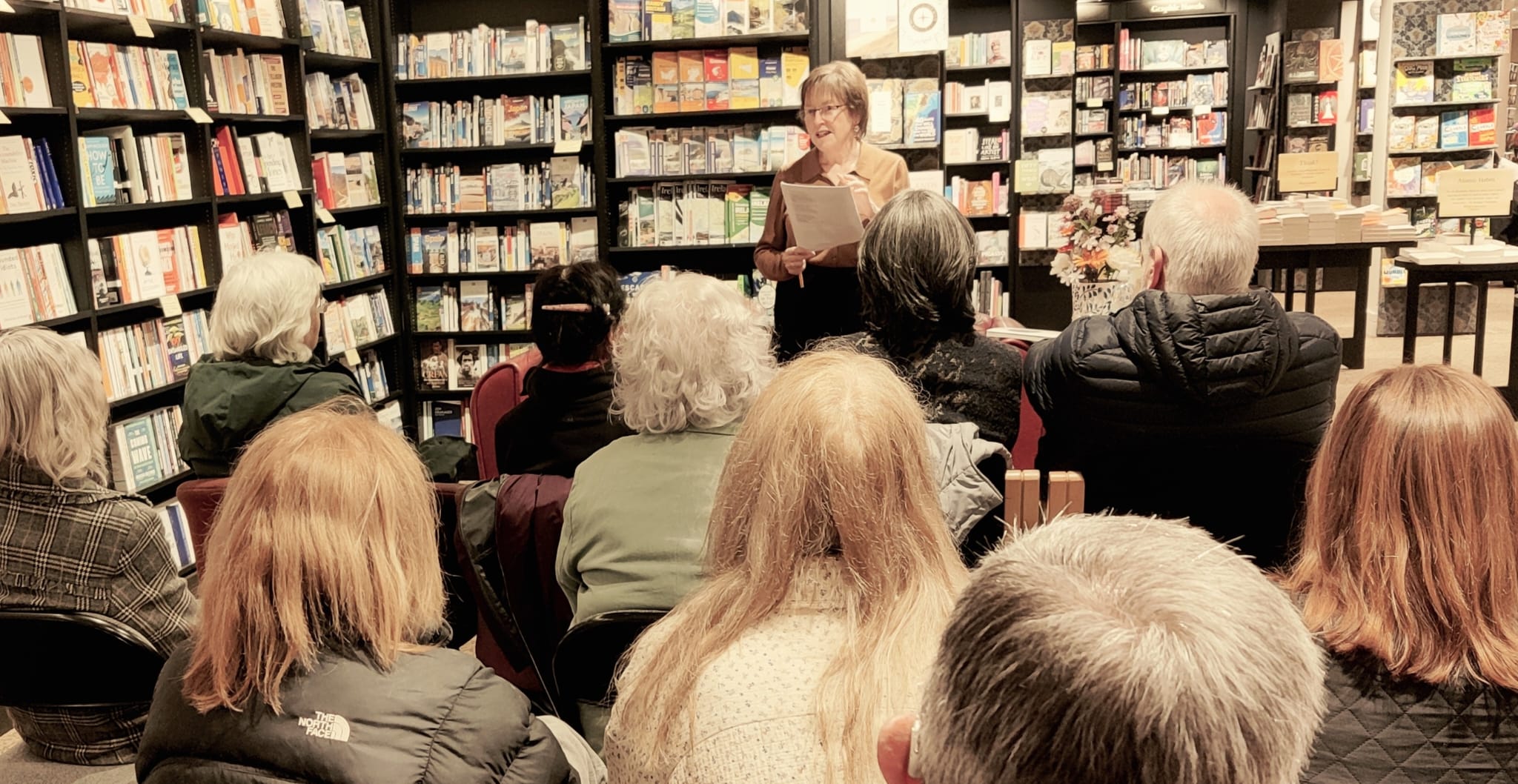
Reading at Button Press’s event at the Farset Hotel, Belfast 26th August.

Reading at the Button Press fund raiser

My poem, ‘By Ordinary Means’ selected for the Performance Trophy at North Coast Writers festival, Portrush. Event 11th October.

Two poems accepted for the Iolo Morgannwg anthology, marking the 200th anniversary of his death.

Poetry reading at Corrymeela International Conference, 18th July.

Poem in ‘Umbra Sumus’ edition of Abridged poetry magazine.

Jan – Apr 2025

A single post for these four months, partly because my right arm has been somewhat out of action for a while so this is a rather rough and ready post . Photo shows Anne McMaster and me with crew on Double Band Films shoot.

https://www.bbc.co.uk/programmes/m00281kw Available to view on BBC iplayer

I’ve completed a poetry collection with the working title EXPOSURE 75 poems on War, Media and Democracy from Culture and Democracy Press.

For The Irish Times, 29th March, I reviewed Richard Wyn Jones’s,  Putting Wales first: The political thought of Plaid Cymru (Volume 1). University of Wales Press.

Nawr magazine published my Welsh-language poem, ‘Newid’ and an article by me about writing about The End of the World in Ulster-Scots, Welsh and English, https://nawrmag.wordpress.com/blog/

The documentary Out Of The Silence, presented by Anne McMaster was screened on 16th February on BBC One Northern Ireland. I featured in this alongside other female authors from NI. View here https://www.bbc.co.uk/programmes/m00281kw

The Linen Hall is an historic library in Belfast, which holds the largest collection of Robert Burns material, outside of Scotland in The Gibson Collection : https://linenhall.com/gibson-collection-samantha-mccombe/. Fragments of Scotch Poetry is the second curation of commissioned poems for the Poetry Jukebox and follows The Lexicon; a curation in English, Irish, French and Breton. I’m one of ten contemporary poets commissioned to write a new poem, inspired directly or indirectly by Burns. These new poems will feature on the Poetry Jukebox at the Linen Hall and at least two other venues as well as online. 

I was allocated Burns’s Address To A Haggis as my starting-point. Having read widely in the Gibson collection I was very struck by Burns’s political commitment and by the facility with verse forms which all the poets demonstrate. So I’ve written a poem about Trump and Netanyahu which draws on both these.

Issue 14 of Offline Journal https://www.offline.wales/ which deals with contemporary photography, commissioned Phil Cope to do one of its separately published long-form essays on the subject of photo-poetry. Two poems of mine which are based on family photographs are featured.

I am delivering four sessions for Ballycastle Writers Group on prose and poetry.