Maureen Boyle is a poet and former committee member of the John Hewitt Society.
Her review is published in Fortnight magazine issue 502 July 2026


Maureen Boyle is a poet and former committee member of the John Hewitt Society.
Her review is published in Fortnight magazine issue 502 July 2026


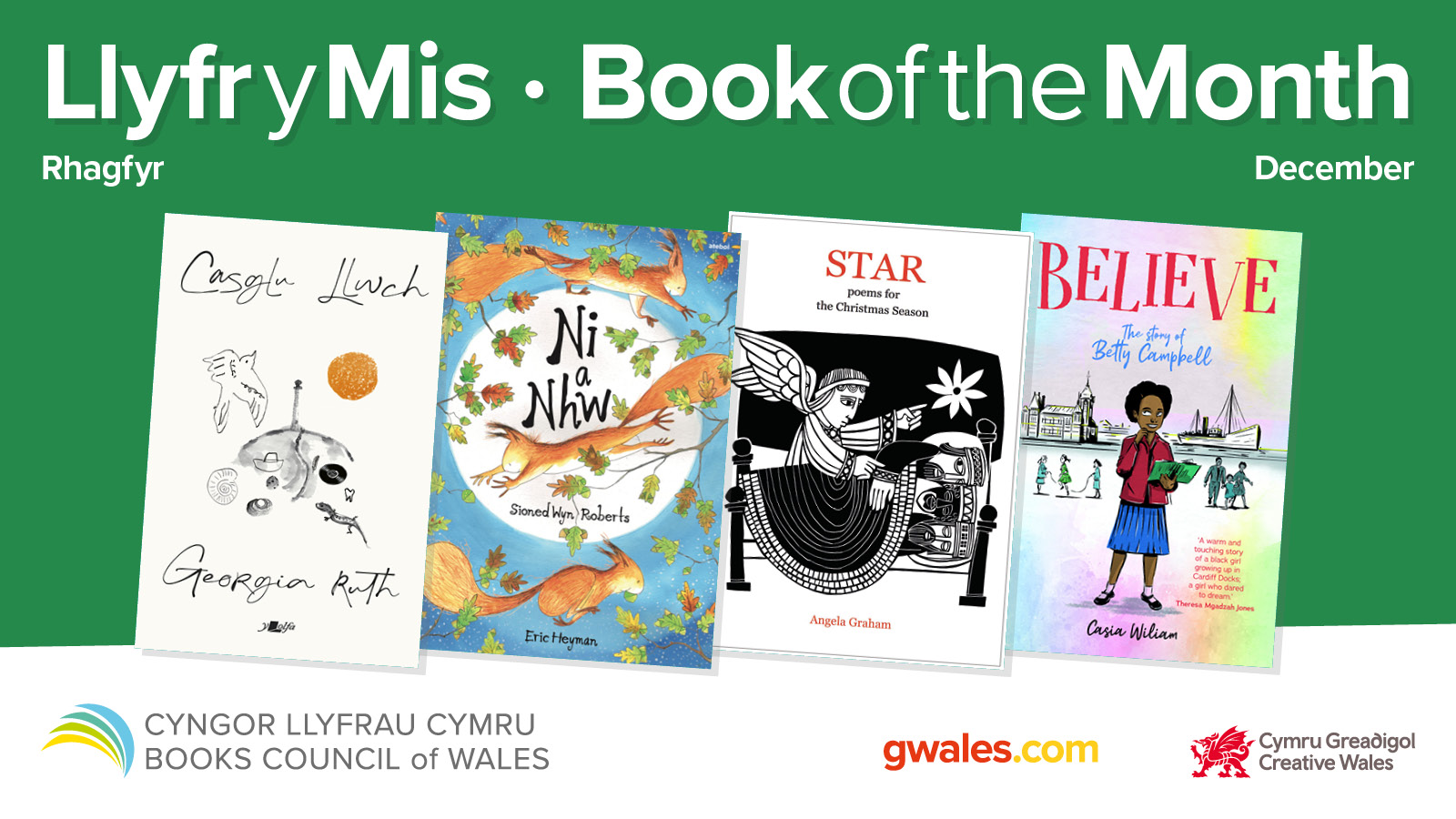
My poetry collection, ‘STAR: poems for the Christmas Season’ has been chosen as the adult, English-language Book of the Month by The Books Council of Wales.
The main objectives as a Books Council for Wales are to support the publishing industry in Wales and promote reading for pleasure.
It was established as a national charity in 1961 in Aberystwyth and employs around 40 members of staff.
On 7th December The Belfast Telegraph carried a feature which allowed me to share something about the books which have inspired me over the years. Maybe there are some of your favourites here!
On Christmas Eve five of my poems featured in ‘Christmas Meditation’ from BBC Radio Wales
After Christmas – always – Childermas:*
Slaughter of Innocents; Threat Neutralised.
The Prince of War, glistening with success,
allures us. This, he says, is what you want.
Not a stable, sheep-herding losers, a star.

On the website of https://thelonelycrowd.org/2023/12/28/new-poetry-december-28th-by-angela-graham/ The Lonely Crowd December 28th.
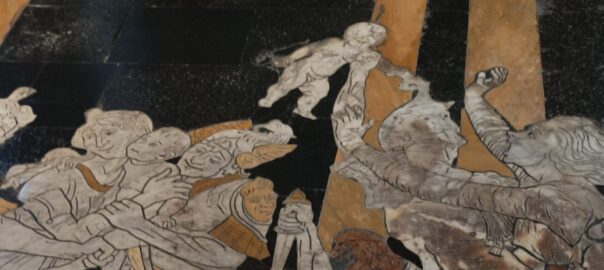
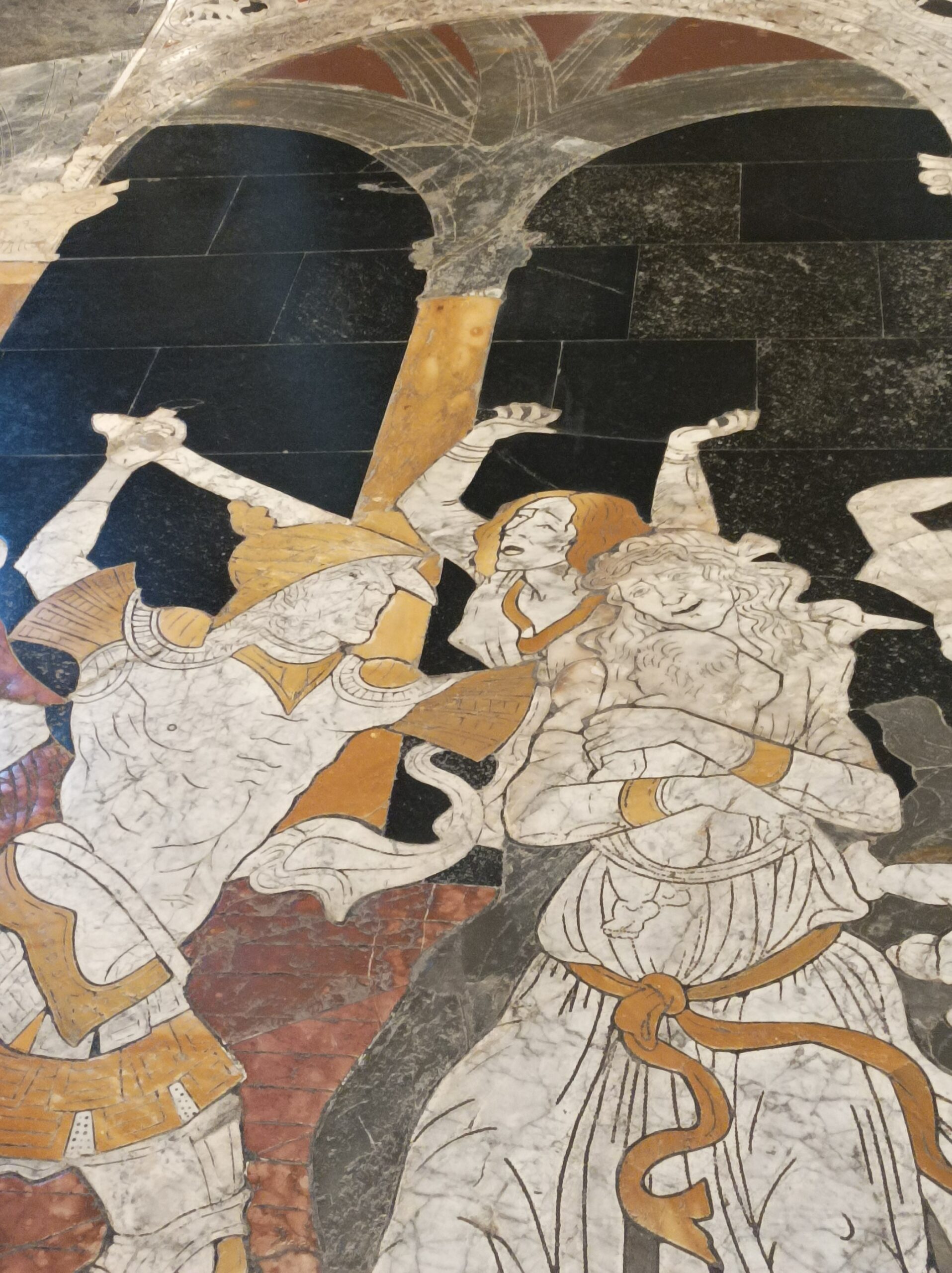
The image is part of a depiction of the Slaughter of the Innocents on the floor of Siena Cathedral, 1481.
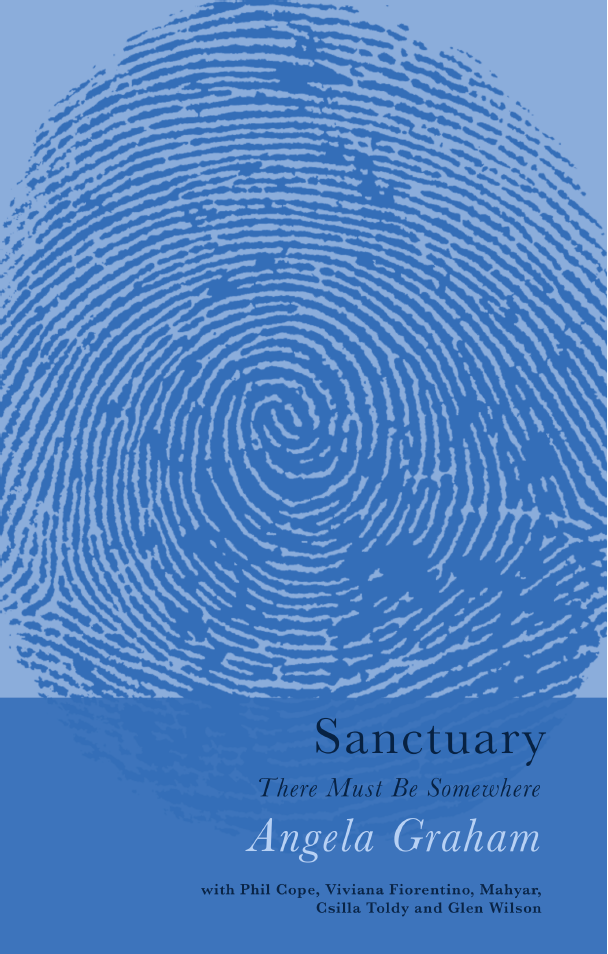
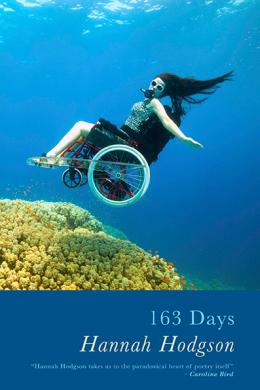
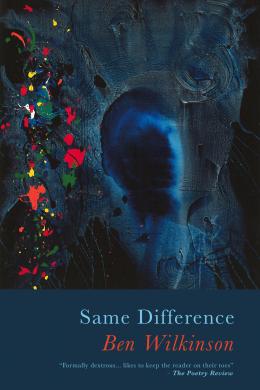
Cardiff Poetry Festival took place over the last weekend in July. I was delighted to read from my collection Sanctuary: There Must Be Somewhere alongside Hannah Hodgson and Ben Wilkinson in a session of poetry newly published by Seren Books.
Hannah Hodgson’s 163 Days employs an innovative format to chronicle her hospital stay and treatments for a devastating illness: extracts from doctors’ notes are juxtaposed with her impressions of the same events. The objective and subjective side by side. Ot, it should be said, the supposedly objective.
The interplay between patient’s and doctor’s perspectives gives the reader a seldom experienced stand point. We spot the subjective seeping into the medical records of treatment – the doctor’s take, not simply on the symptoms, but on the patient who is experiencing them. This either clarifies or clouds the decisions taken. To hear the patient’s voice almost simultaneously is to encounter a different kind of authority, that of the suffering subject, who is perfectly capable of reading the symptoms the doctor (unconsciously) presents but who is accorded little recognised power. Power, its facets and its use, is a constant throughout the book.
Although one might say that the poetry in this book resides in the patient’s contributions, which employ devices typical of poetry as contrasted with the prosaic and precise medical use of language, part of the book’s appeal is that the affect-less medical notes acquire an emotional intensity as they collide or elide with the poetic voice.
This voice is robust but never strident. This admirable self-control achieves a great thing: it allows the reader to supply the anger, bafflement, hurt.
A memorable, epic journey.
Ben Wilkinson’s new collection examines relationships, sometimes from a wry perspective, as a poem’s protagonist grows in self-knowledge – painful as well as uplifting – with a deft handling of a variety of forms.
It is particularly interesting to see a contemporary poet ‘coming to terms with’ a long-dead one, in this case, Verlaine: proof that poetic voice can remain vital, challenging and inspiring.
Running (an art or a sport?) is here given a poetic ‘voice’. One way for those not devotees to get inside an activity that can seem from the outside supremely individual.
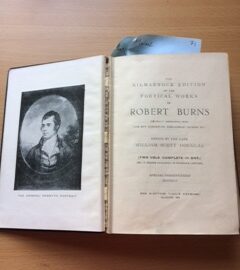
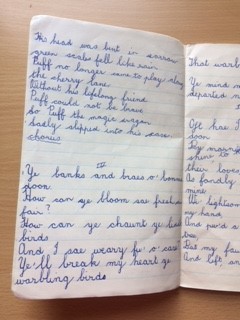
How did I first encounter the poetry of Burns? I wouldn’t have been able to tell you till a few days ago. I came across a small school exercise book, carefully covered in brown paper, on which I’d written the word ‘Songs’ on one cover and ‘Poems’ on the other. I would have been seven years old and the teacher must have written on the blackboard for us to copy down texts in our very best handwriting.
The poems are a mixed bag. The first, I have carefully noted, is by ‘Lord Tennyson’, and I will pass over it because I wasn’t impressed. One of his weaker ones. Didn’t he have better things to do, I wondered. Among the poems was a long one by Thomas Campbell, The Irish Harper. It’s a lament for ‘poor dog Tray’. I know now that Campbell was a Glaswegian (1777 – 1846) who despite a very small poetic output managed to exert much influence on the poetic scene of his day.
Here I’m making a wee aside to recommend Duke Special’s rendition of On Account of My Dog Fido (” oh my dog what have you done? and why have you forsaken me?”). This is a genuinely affecting dog lament from the Francis J. Bigger collection in Belfast Central Library. It’s on A Note Let Go, a marvellous album made with Ulaidh which includes some poem/song work and mines the Bigger collection .
https://www.ceolmusic.ie/products/ulaid-duke-special-a-note-let-go-cd-lp
I’ve blogged previously about other aspects of the album here.
The poems in my school jotter are not the best nor the worst examples of the art but it wasn’t among them that Burns appears. He is in the Songs section. Following on from Puff The Magic Dragon is: Ye banks and braes… (two songs of loss!). There are several Scottish songs in this homemade anthology and a couple in Irish, written conventionally and phonetically. This is how it should be: one language alongside the other.
It was through the song versions of Burns’s poems that I got to know his work. I seem always to have known My luve is like a red red rose… And a Scottish friend singing For a’ that blew me away. Simply delivered, with conviction, the refrain convinces us that the truth is simple: it’s not outward show or possessions that count because every individual is inherently worthy by virtue of being human. The poem, or song, makes its confident assertion that, ultimately, right values will prevail.
For myself, as a poet, to reimagine Rabbie means letting his work inspire me to reimagine myself, my society and my role in that society. As a writer, what am I for? What is my purpose? I won’t ignore the lesson Burns offers that poetry as singable lyric extends the poem’s reach and expands it beyond poet and solitary reader.
https://linenhall.com/events/rabbie-reimagined-gibson-burns-and-belfast/
I’ve chosen another poem that is also a song, John Anderson, my jo, John.
This is a poignant yet celebratory account of a long relationship. And a lovely song.
Angela Graham is a film maker, writer and poet. Her short story collection A City Burning (Seren Books) was longlisted for the Edge Hill Short Story Prize 2021. Her poetry is widely published.
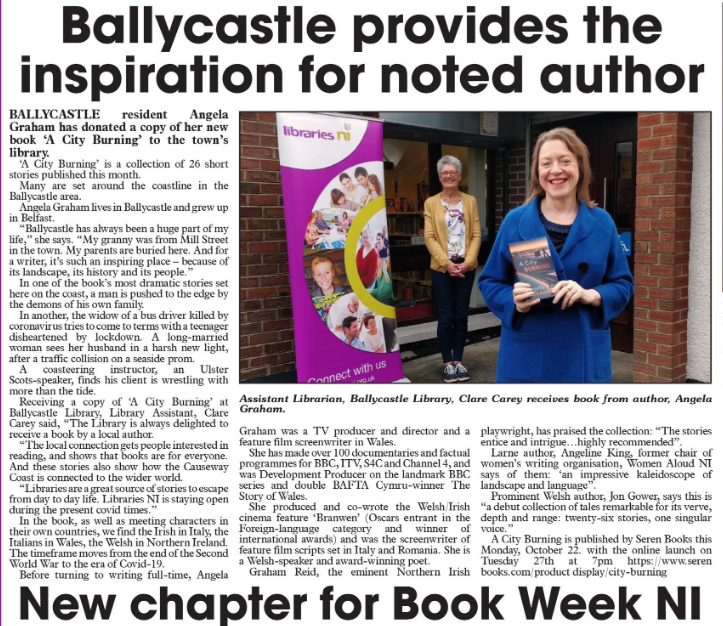
I am delighted to give a copy of my new book to Ballycastle Library, as seen below in a piece from The Ballycastle Chronicle, 20th October 2020. 
Among the 26 stories in ‘A City Burning’, many are set around the coastline.
The area is inspirational and the library is certainly keen to inspire writers and readers.
I can’t wait to see my book on the shelf in the library, in due course.
Two of the stories were written during lockdown. The setting of one is partly inspired by a stretch of Ballycastle Beach.
A City Burning is published by Seren Books.
In 2 poems by Gaynor Kane we find the glowingness of whin in these contrasting views of the same countryside.
Gaynor is from East Belfast. She came to writing late, after finishing a (mid life crisis) degree with a creative writing module. In October 2018, her micro pamphlet, Circling the Sun, was published by Hedgehog Poetry Press. Tradition appears in her poetry pamphlet, Memory Forest, on last wishes and burial rites.
Tradition
A whitewashed cottage holds the family tight,
Him – all boxed in oak and brass,
and the priest – who’d visited often that final week.
Everyone else spills out across the yard,
against paddock fences, down the lane
where daffodils bud, their heads bowed.
Burnished whin bushes catch the low sun.
Oil slicks ripple on pothole puddles.
Three hee-haws, long and low, cut silence.
Whinnied responses stuttered from four in hand,
drafts as dark as Guinness, their plumed
headgear like black clouds dancing.
Plaited tails, the smell of leather and Brasso,
oiled hooves shine, the clop of shoes shifting weight.
They breathe in sombre air, exhale acceptance.
Glass carriage, reflecting dark
pallbearers in top hats and tails
fit with Dickensian demeanour, gloved hands.
The procession takes the obedient pace
of cows to milking, along the long lane.
Every man takes a lift, order called by respectful nods.
Rural men, mostly farmers with dirty fingernails,
performing the graceful choreography
of a symbiotic ceremony. Cars convene
Ardkeen to Ballyphilip, to an ancient graveyard
on Windmill Hill, overlooking the mouth
of Strangford Lough, where he is laid to rest.
https://www.hedgehogpress.co.uk/2019/09/26/autumn-books-memory-frost-by-gaynor-kane/
Gaynor says:
The Low Country is the name for the lower Ards area of the Ards peninsula – from Greyabbey to Portaferry. We moved from Belfast to Kircubbin to get away from sectarianism.
Cross Roads
When I left school, I crossed a bridge
to work. I was thrown into a world filled
with names I struggled to pronounce.
There I met a boy, from the other side of town.
Friends at first – we talked about our weekends,
shared stories, laughed at youthful antics.
Then I moved, back across the bridge, back
onto familiar roads. We stayed in touch.
Later, we had our own home, mid-terrace,
on a road with coloured kerbs, it didn’t matter
which. Inside was neutral, magnolia walls, beige
carpets and a coffee coloured bathroom suite
City folk, we lived in fear of angry balaclavas;
crossfire cutting communities in two.
Sirens resonated across the Belfast sky.
We took to the roads looking for a haven.
In The Low Country, whin bushes shone under
a hay-bale sun, the lough glimmered. Harbour
boats waltzed on golden strands of summer.
Red and black flags adorned main street houses.
A loyal arch, arced across that same road;
we exchanged knowing glances, we wouldn’t
be taking chances. Surveyed the site
and soon after foundations were footed
Years later we migrated; held hands, gold bands,
under a calypso sun and returned as swans.
Added to our brood, just once;
let her choose
which cross to wear,
if any
Cross Roads will appear in Gaynor’s debut poetry collection Venus in pink marble, soon to be released by Hedgehog Poetry Press. Website: www.gaynorkane.com
In Yvonne Boyle’s thought-provoking poem, whin serves as an emblem of both love and conflict. It appeared in the Easter 2018 edition,’Spring’s Bride’ of The Bangor Literary Journal .
Yvonne says, The whin or gorse blooms in spring and it’s also: ‘when a young man’s fancy turns to thoughts of love..’ (Alfred Tennyson). I had been talking with my partner about Easter and eggs. I remember my mother dying eggs with gorse blooms in my childhood but I had never thought to do it myself again until he suggested it. And I kinda liked that he knew about ‘old customs….’
Yvonne has had poems published in The Dunfanaghy Writers’ Circle publications, The Bangor Literary Journal and The Community Arts Partnership’s Poetry in Motion Anthologies (2017, 2018). She is a NI Arts Council (SIAP) Awardee 2018/9 and a member of Women Aloud NI.
Want to know about furze? Find all you could want in FURZE: a Survey of its History and Uses in Ireland by A.T. Lucas. This detailed and fascinating book was published by An Cumann le Béaloideas Éirinn (The Folklore of Ireland Society) in 1960. More than 200 pages of information and analysis.
My thanks, once again to Róise Ní Bhaoill for telling me about this book.
Continue reading Gorse, Whin, Furze 5 – Names – a shared love in Irish, Ulster Scots, Scots English