Category Archives: Blog

New Impetus in Ulster Scots Writing

Ding Doon Tha Mairch Dykes – a quotation from a collection of poems by Stephen Dornan heads up this article by me in The Irish Times of 3rd March 2021 here

In 2017 I received a SIAP Award from the Arts Council of Northern Ireland towards research for a novel set in NI. One of the most striking currents in the air was the turbulence around issues to do with language, with Ulster Scots and Irish. The Stormont Assembly collapsed partly because of apparently irreconcilable pressures around the way people speak; how they write; their cultural ‘reading’ of the land itself.

Language and land – two permanent pieces of the NI puzzle. Language embedded in land, in heart, in psyche.

I noticed also some important shifts in population presence within Northern Ireland; the move from city to country; the changing ownership of land and property; demographics impacting on communities.

From these arose a contemporary story, but it could only be told, I felt, through English,  through Ulster Scots, through Irish.

I didn’t find it hard to access materials in Irish or to access advice but when it came to Ulster Scots, although I had that in my inner ear from my father’s side of the family (as I had Irish from my mother’s), it was a much tougher enterprise to gauge its contemporary use, to inflect this according to age, area and class. Some of the reasons for this are mentioned in my article.

I am enormously grateful to each person who has helped me along the way, in both Irish and Ulster Scots.

I am absolutely delighted that, in these few years, there has been an opening up in the Ulster Scots field, a writerly energy that wants to be expressed across forms and registers. Again, the article touches on this but there would be much more to say and report.

I would like to see, in Irish publishing, particularly among journals and magazines, a greater readiness to consider publishing – alongside English – Irish and Ulster Scots too. The Bangor Literary Journal published a pair of sonnets I wrote in Ulster Scots and English. The sky didn’t fall in.

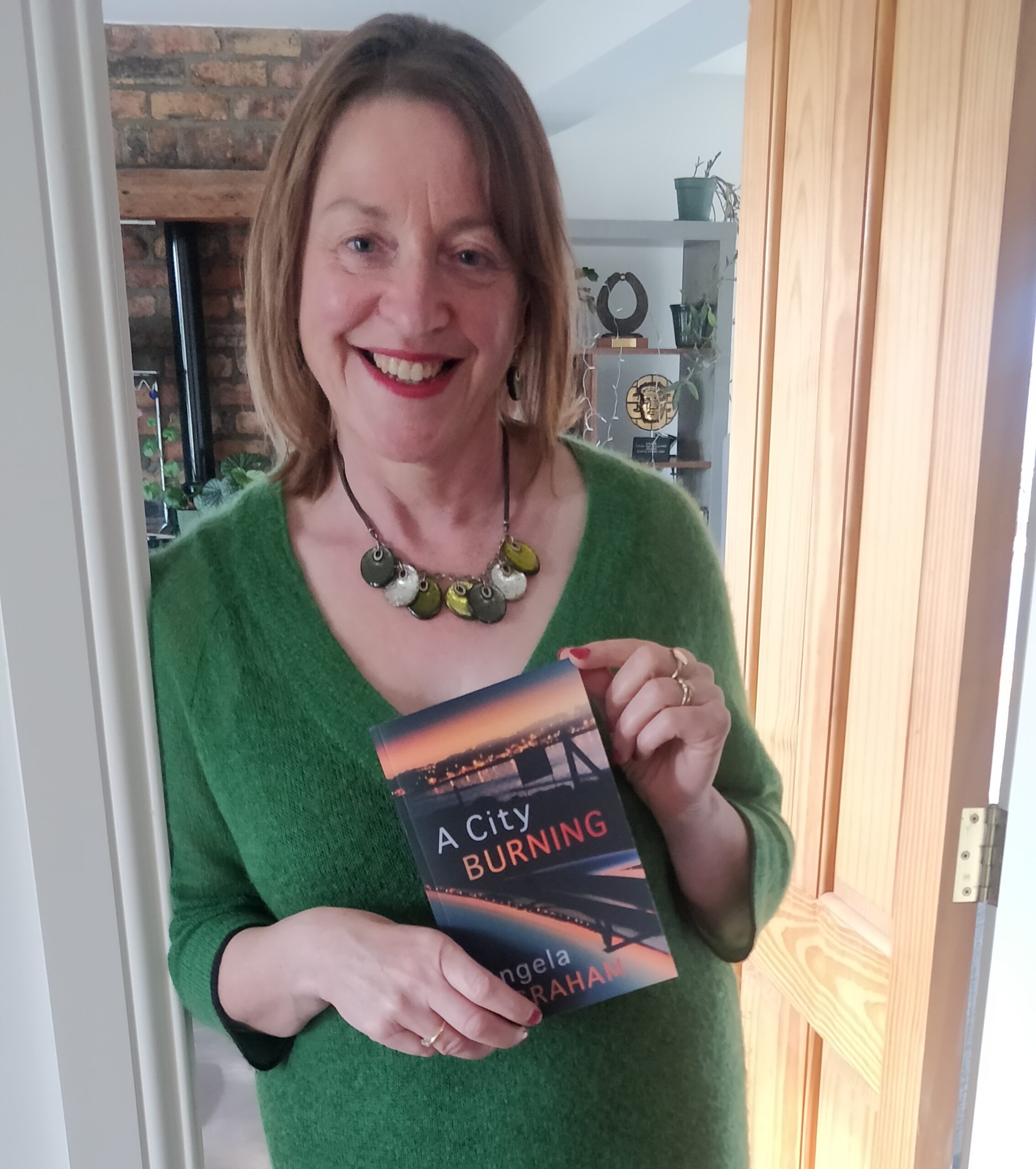
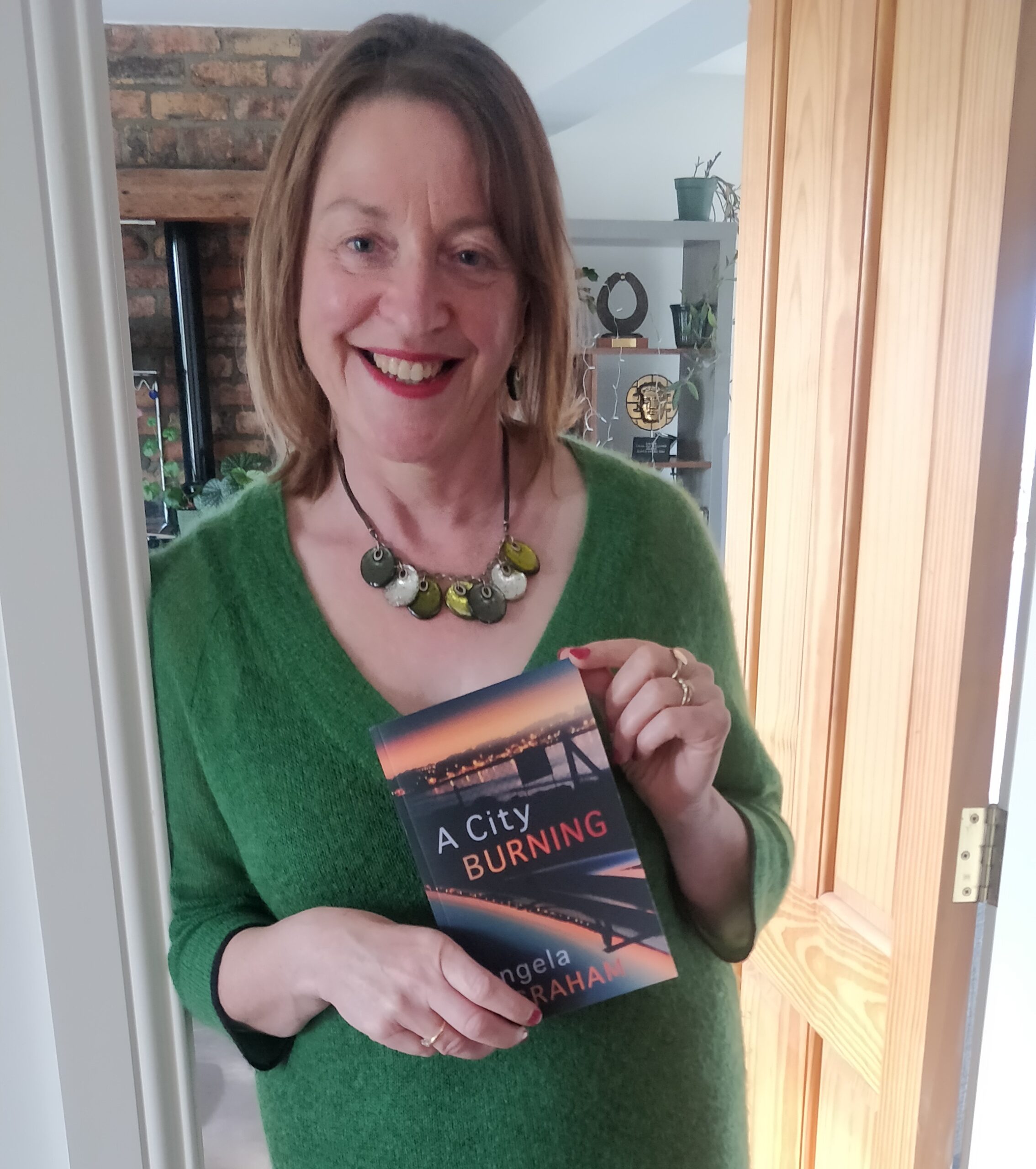
I wrote a story partly in Ulster Scots for my collection A City Burning. The publisher, Wales-based Seren Books, was interested in the calibre of the work, its intelligibility, its coherence and the Ulster Scots earned its place on those terms.

There are challenges to trying to get Ulster Scots (a) written and (b) published outside specialist publications. Where is the material? Who is to judge its competence? Can Ulster Scots recover itself enough to flourish today?

These are questions appliable, in varying degrees, to any minority language or dialect.

Certainly, no one gains from setting one form of expression against another; or from over-zealous gate-keeping about standards (though these must exist or expression gets catastrophically unmoored from its roots); or – most insidious of all – who is to be allowed to write in Ulster Scots.

That last was the pressure that threatened most powerfully to hold me back. But I have finished the first draft and it has been a wonderful experience to live with the characters, and particularly the Ulster Scots speakers, seeing the world through those eyes, speaking with that tongue.

But perhaps the time has arrived when a new set of questions can be asked: Why not in Ulster Scots? Why not me? Why not now?

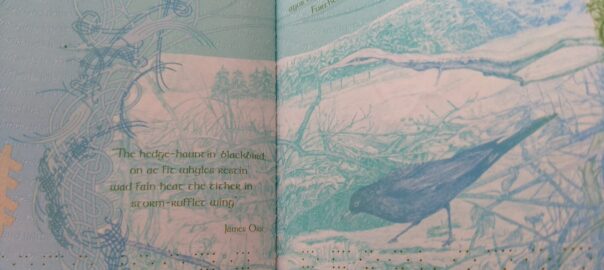
The Header illustration is a page from the passport of Éire / Ireland: Ulster Scots words, by James Orr
Time To Write Around The Coast of Ireland

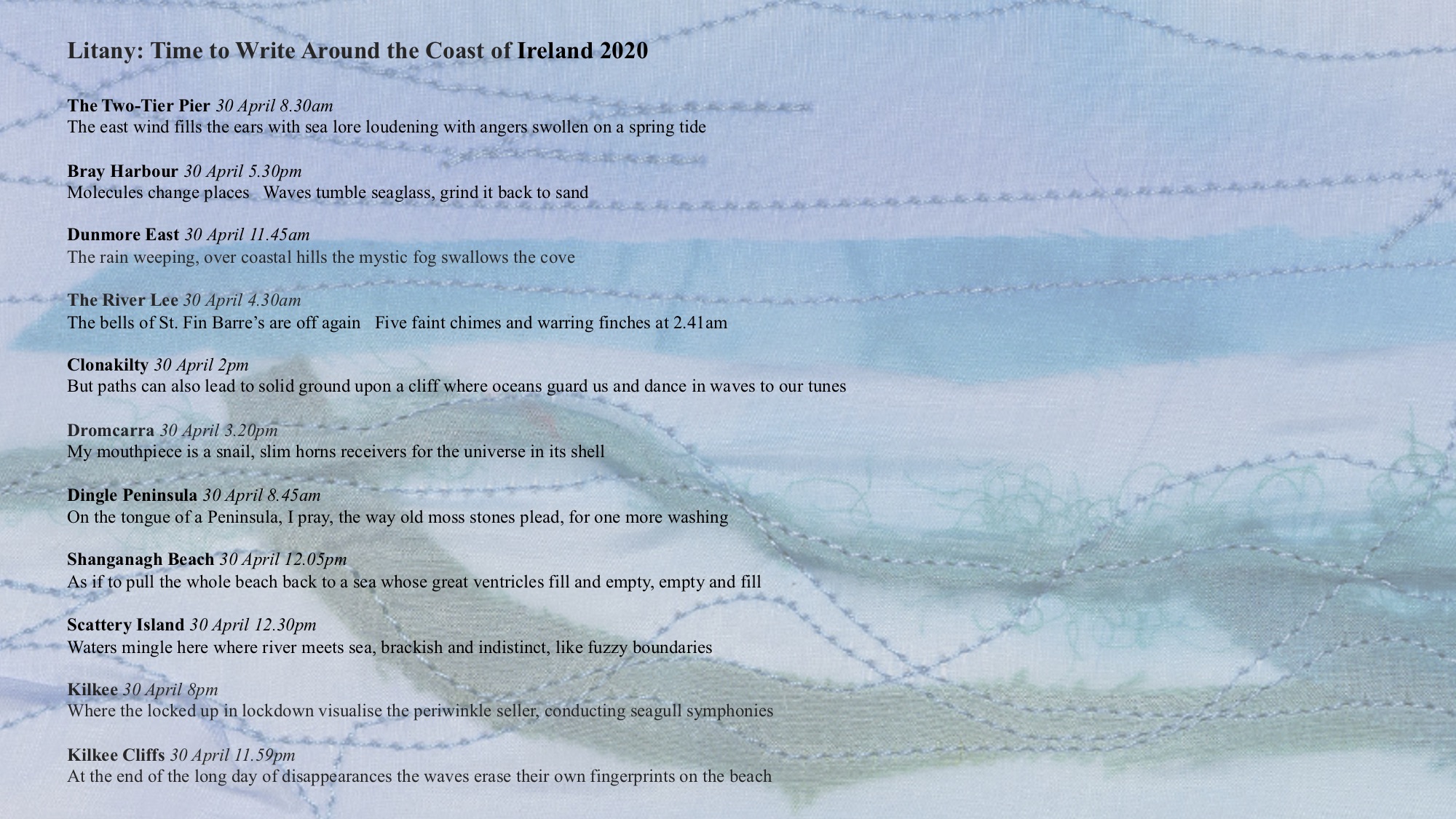
Maria Isakova Bennett celebrates Poetry Day Ireland 2020 by the creation of a collaborative poem made up of lines she has selected from poems specially written on that day with the sea as a theme. I chose to write about Broughanlea Townland where I live near Ballycastle.

Her beautiful stitching work enhances the presentation of the lines as they create, together, a harmony of sea sounds.

Collaborative Litany – Time To Write Around The Coast of Ireland 2020

The opening section

My poem, FULL CIRCLE, BROUGHANLEA TOWNLAND, COUNTY ANTRIM is part of the work I am doing on Place and Displacement for which I recieved a SIAP Award from the arts Council of Northern Ireland in 2019.

Maria hopes to arrange a reading involving all 34 contributing poets around the coast of Ireland when circumstances allow.

This lovely project brings together poetry and embroidery, two things I’m very keen on. I have plans for a stitched seascape!

Writing Today in Ulster Scots

My blog for The Irish Literary Society: irishlitsoc.org

Why is it so hard to find writing in Ulster Scots among contemporary publications? Has it gone for good or is it poised to make a come-back?

Up to the mid-twentieth century it was commonplace to find Ulster Scots poetry and prose in literary magazines or in newspapers but now it is exceptional. Although there is a body of Ulster Scots work appearing in specialist sources this work often deals with the past. In contemporary creative writing, Ulster Scots is all but invisible. A language without a lively, multi-genre, modern literary and cultural presence is one that is struggling. The degree to which Ulster Scots achieves such a presence is a litmus test of feasibility and relevance, even of its existence as a spoken medium.

In the last census in 2011, there was, for the first time, a question about capacity in Ulster Scots. Based on the census returns, the Ulster-Scots Agency states “there are approximately 140,000 people who have indicated some ability in Ulster-Scots.” However, the number claiming a capacity to speak, read, write and understand Ulster Scots is only 0.9 per cent of the population of Northern Ireland. The spoken language is under pressure and the gap between the spoken and the written word has been allowed to widen.

Ulster Scots is the speech that developed (or whose development intensified) as a result of the in-migrations of Lowland Scots to Ulster from the early seventeenth century…

Read the full piece here: https://irishlitsoc.org/writing-today-in-ulster-scots/

About: The Irish Literary Society

The Irish Literary Society was established in London in 1892, succeeding the Southwark Irish Literary Club. Among its founders were W. B. Yeats, T. W. Rolleston, Francis Fahy and Douglas Hyde and other leaders of the Irish literary revival. The Society was formally founded with Sir Charles Gavan Duffy as President, at the Caledonian Hotel, The Strand, 12 May 1892. Evelyn Gleeson was its first secretary.

Stopford Brooke gave the inaugural lecture to the society on “The Need and Use of Getting Irish Literature into the English Tongue” (Bloomsbury House, 11 March 1893 – its delivery delayed to allow for the start of the National Literary Society in Ireland). Although the business of the ILS has always been conducted in English the Society was influential in nurturing the revival of the Irish language by programming language classes even before the Gaelic League was formed in 1893. 

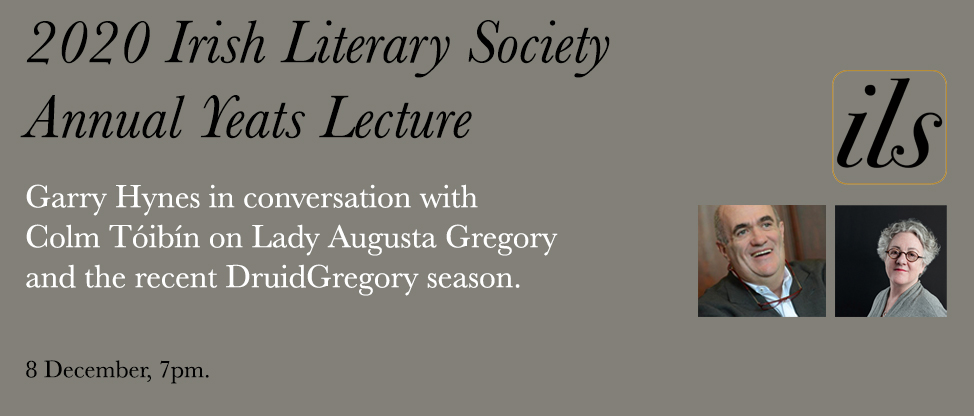
Next event 8 December, 7pm

https://irishlitsoc.org/event/7th-annual-yeats-lecture-8-december-2020/


Profile in The Irish Examiner of ‘A City Burning’

A very positive verdict in The Irish Examiner from  Sue Leonard

Short, sharp and sometimes shocking, these wonderful stories truly pack a punch.

Sue’s long-running weekly profile Beginner’s Pluck offers a snapshot of a new writer and their debut work.

There’s a strong theme of witness in these 26 stories, which are set in Wales, Northern Ireland, and Italy. The characters face different challenges, from a failed marriage to eulogising a hated terrorist, but each of them is at a moment of change, needing to reassess their beliefs, or image of themselves. 

In an enjoyable interview with Sue she asked what I would be ‘in another life’. To my own surprise I said I would like to be an expert ballroom dancer. That will surprise those who know me but it’s true! I don’t watch Strictly but, yes, sweeping rhythmically around a floor is the life I haven’t had… yet.

Review of ‘A City Burning’ by Prof Diana Wallace

Prof Diana Wallace researches women’s writing, with special interests in historical fiction; Welsh writing in English and Modernism and the Gothic.  She is co-director of the Centre for Gender Studies in Wales and Leader of the English Research Unit at the University of South Wales. Her review appears on the website of the Centre for the Study of Media and Culutre in Small Nations at the University of South Wales.

Centre for the Study of Media and Culture in Small Nations

How can writers respond to sudden, even exponential, change? It can take a decade, as it did after the first world war or 9/11, for novels and memoirs to catch up as writers process traumatic events. And readers, time-pressed and battered by 24-hour news, may turn to genre fiction for the comfort of familiar plot lines and predictable endings.  The short story, on the other hand, can turn on a sixpence to give us a snapshot of our crises in real time. Compressed, intense, often challenging, some of the most powerful examples of the form have come from writers on the so-called margins: women, immigrants, people from ‘small nations’ such as Wales and Ireland.

Angela Graham’s assured and compelling debut collection, A City Burning, ranges across Wales, Northern Ireland and Italy. It offers 26 brief stories, most no more than a few pages (one a mere page and a quarter), which turn their forensic flashlight on a moment of change when a character has to make a choice. Continue reading Review of ‘A City Burning’ by Prof Diana Wallace →

Introducing Angeline King at ‘Dusty Bluebells’ Launch

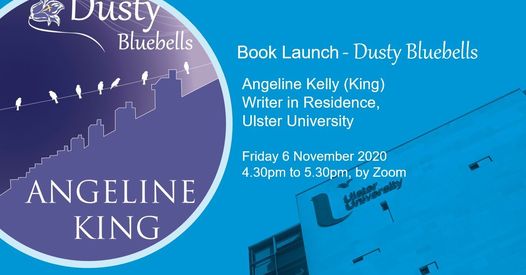
I was so pleased to be introducing Angeline King at the launch at Ulster University on 6th November of her novel, ‘Dusty Bluebells’. This is an important book in the history of writing in Ulster Scots – about which we heard more from the experts.

I met Angeline early in 2018 when I was looking for writers working in Ulster Scots while  I was researching for a novel I’ve since written about issues to do with language in Northern Ireland.

I was quickly impressed by Angeline’s particular type of intelligence. In our conversation she mentioned coming up against an obstacle of one kind or another in her creative life, as everyone does, but I noticed that, each time, she had analysed the situation and gone away to learn more about the elements involved and then returned, better equipped to tackle the issue. I noted that she regarded learning a foreign language in order to dissolve a barrier as something that was perfectly feasible. It just required application. She has a BA in French and History and an MA in Business and Applied Languages – French and Spanish –and she has also learned Dutch. Continue reading Introducing Angeline King at ‘Dusty Bluebells’ Launch →

On ‘Your Place And Mine’, BBC Radio Ulster

It was lovely to have this [click here to listen Interview with Anne Marie McAleese ] on Your Place And Mine BBC Radio Ulster 7th November. This long-running and much-lauded series focuses on place. We talked about the role of place in my short story collection A City Burning.

I read an extract from the story Coasteering in which a middle-aged woman and her Ulster Scots-speaking coasteering instructor venture far out along the coast at twilight:

‘Dinnae ower-think it!’ Alec urged, and then repeated himself….

I loosened the cuffs of the waterproof jacket that added a layer to the battered old wetsuit he’d provided. Seawater gushed out past my wrists. I poised myself, leapt − an un-timeable gap − and was smothered in crashing bubbles and noise and resistance, then broke upwards into air and the push and pull of the sea. This was what I’d wanted, to be out beyond the little beaches and rock-strewn shores; to be out of my depth but safe; to be gripped by the sea’s power but not at its mercy. I respect the sea. I fear it…. Continue reading On ‘Your Place And Mine’, BBC Radio Ulster →

Interview with Seren Books on ‘A City Burning’

As her debut short story collection A City Burning, is published, we interview Angela Graham to find out more about the book and what inspires her.

In the twenty-six stories in A City Burning, set in Wales, Northern Ireland and Italy, children and adults face, in the flames of personal tragedy, moments of potential transformation. On the threshold of their futures each must make a choice: how to live in this new ‘now’. With a virtuoso control of tone, by turns elegiac, comic, lyrical, philosophical, A City Burning examines power of all types. The result is a deeply human book full of hauntingly memorable characters and narratives.

What is the meaning behind the title A City Burning?

In the opening story, ‘The Road’, a young girl witnesses her city blazing. She understands that this is a sign of the collapse of the status quo, of all the usual certainties. She is confronted with the need to react to this new situation. What values should guide her in this choice? I realised that this story encapsulates the theme of many stories in the collection – witnessing major change and having to work out a response. It seemed a fitting title for the book.

Belfast on a November evening

Continue reading Interview with Seren Books on ‘A City Burning’ →

A City Burning: Angela Graham talks about that title

video shot and edited by John Geraint

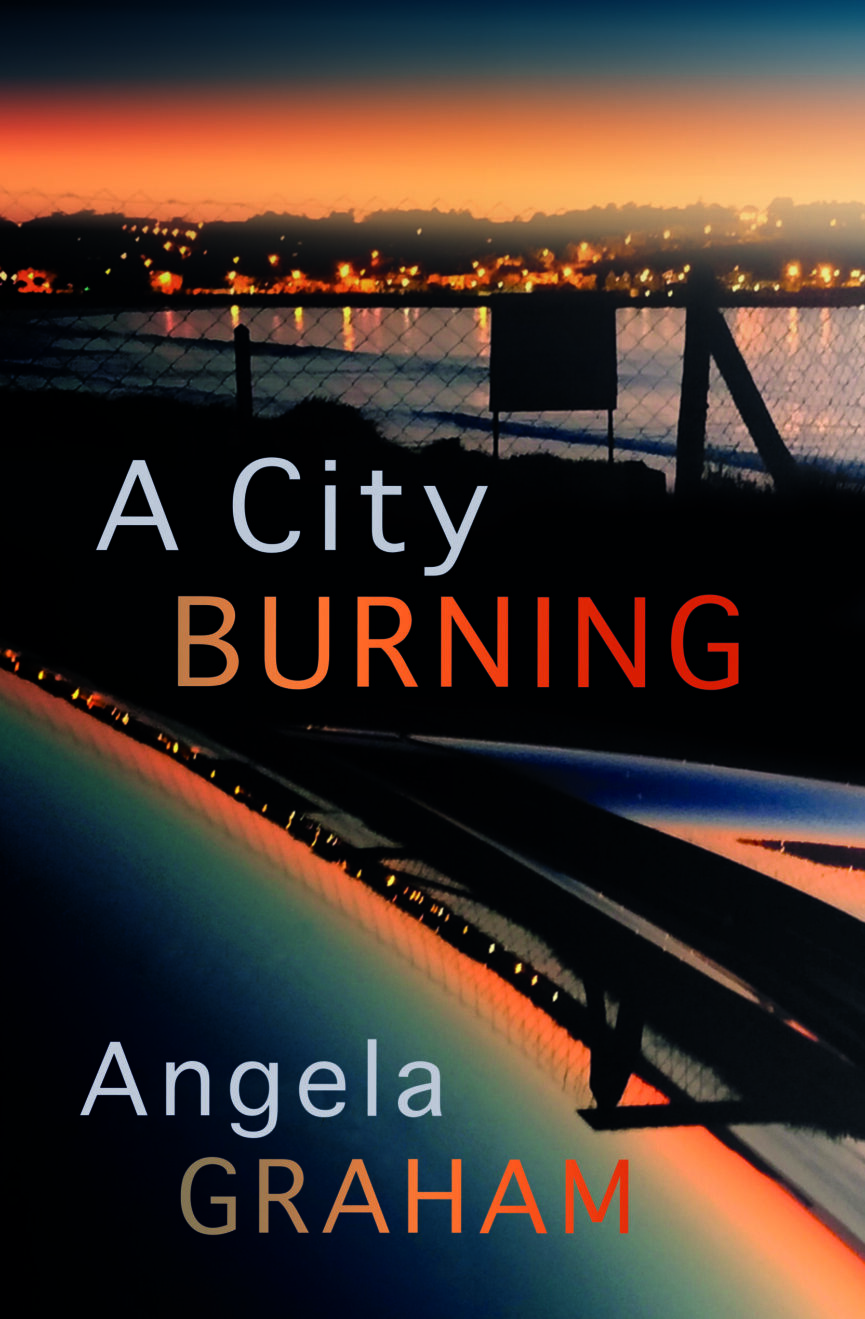
A City Burning from Seren Books

26 short stories set in Wales, Northern Ireland and Italy, from the end of the econd World War to the Covid pandemic.

With a virtuoso control of tone, by turns elegiac, comic, lyrical, philosophical, A City Burning examines power of all types, exploring conflicts between political allegiances; between autonomy and intimacy; emotional display and concealment; resistance versus acceptance. The result is a deeply human book full of hauntingly memorable characters and narratives.

These stories are not comfortable… but they are honest, searing, insightful and very, very good.” – Inez Lynn Continue reading A City Burning: Angela Graham talks about that title →

Welsh, Italian, Ulster Scots – 3 wonderful readers at ‘A City Burning’ Launch

I’m so delighted to have 3 wonderful readers to deliver extracts from my short story collection A City Burning at its launch on 27th October at 7pm: 26 stories set in Wales, Italy and Northern Ireland:

Geraint Lewis from Tregaron, west Wales, actor, playwright, novelist and short story writer.

Viviana Fiorentino from Italy, poet, novelist, translator and activist on migration policy.

Liam Logan from Dunloy, County Antrim, media presenter, film maker and writer on Ulster Scots in prose and poetry. Continue reading Welsh, Italian, Ulster Scots – 3 wonderful readers at ‘A City Burning’ Launch →