Category Archives: Television

Hungry Wales in an Age of TV Plenty

If a thing is repeated often enough it begins to be as persuasive as though it were true.

We’ve never had it so good, apparently. We live in a televisual Age of Plenty with digital wares piled high in the marketplace and so it’s time for the BBC to withdraw from universality and to stop disadvantaging the commercial sector by its scale and success; the level of public funding gives the BBC an unfair advantage over its competitors and the BBC should become more ‘distinctive’, confining itself to things the market can’t or won’t provide.

cymru_wales

Continue reading Hungry Wales in an Age of TV Plenty

TV for Wales – in both languages

It’s not just S4C that is threatened by potential changes. It is television for Wales as a whole, if the latest BBC Wales Annual Review 2014-15 by Audience Council Wales is anything to go by.

This Review, for 2014 – 15, makes alarming reading, particularly as it comes hot on the heels of Ofcom’s recent special additional report on  PSB in the internet age: The Nations of the UK and their regions and the bombshell about funding burdens for the BBC lobbed by the Chancellor while no one was looking. It appears the day before the Green Paper on BBC Charter Renewal is expected but it shouldn’t get lost in the sturm und drang that that is likely to produce because it has significant things to say about television in Wales.

Continue reading TV for Wales – in both languages

BBC licence fee raid ̶̶ The consequences for Wales

cymru_wales 

This blog appeared on 10th July 2015 on the IWA’s clickonwales blog site.

For the second time in five years Government Ministers have backed the BBC into a corner, issued a ‘money or your life’ threat, walked away with a big chunk of the licence fee and left a Director General making as good a public fist of defending ‘the deal’ as he can. Has this been a fair trade between a willing buyer and a willing seller? Continue reading BBC licence fee raid ̶̶ The consequences for Wales

Crabb Deal on Broadcasting in Wales is not secure yet

See IWA Click on Wales blog page 9th March

Crabb Deal on Broadcasting in Wales is not secure yet

When Stephen Crabb, the Secretary of State for Wales, stood up on 27 February to proclaim a (fragile) cross-party consensus on further powers for Wales, he did so only hours after Ofcom, the media regulator, had closed its consultation on the future of public service broadcasting. Ofcom’s review and the Crabb ‘consensus’ represent potentially important milestones for broadcasting in Wales.

What the premature St. David’s Day agreement (a Sunday announcement was never on the cards) had to say about broadcasting, unsurprisingly, made no headlines, but it laid down an important marker for the coming debate on the BBC’s Charter and for the need to deepen Welsh involvement in media policy. There is a huge amount at stake both for viewers and for our television production industry.

Apparently, all four parties are now agreed on proposals that the IWA has supported and promoted for some years past in various publications, and in the evidence that it submitted to the Silk Commission by the UK’s Changing Union project in which it has been an active partner. It did so again last week in its response to Ofcom’s consultation document.

Mr. Crabb’s Command Paper says there was consensus around the following Silk Commission proposals: Continue reading Crabb Deal on Broadcasting in Wales is not secure yet

ACS and DOCS – Academics and TV Documentary-making

ACADEMICS AND TV DOCUMENTARY-MAKING

 A WORKSHOP for CARDIFF UNIVERSITY GRADUATE COLLEGE

11TH    February

book-a-workshop-new

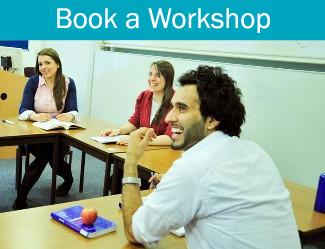
This is the fourth year I’ve presented this 3-hour workshop. I designed it as a contribution towards bridging the gap between the media and academia. I believe it still to be an unusual offer amongst university training because media training offered to academics is usually in the area of short-form and news-related input, not in long-form documentary. Between these two forms there are significant differences in working practice for journalists and, from the academics’ perspective, the skills needed to have a happy time as a contributor to a documentary are different to those that will produce a snappy sound-bite.

Academia and the media are two worlds which can intersect very fruitfully. However, when they don’t understand each other’s priorities and practices there are sometimes tears before bedtime.

The workshop is designed to examine key aspects of both worlds: what do they value? what do they want? what are they for? Where do these overlap and where must one recognise that they differ? Continue reading ACS and DOCS – Academics and TV Documentary-making

DNA CYMRU series gets underway

B9_nHx6IQAAm1c1

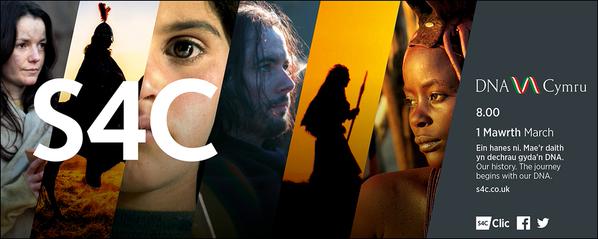
8pm St David’s Day our new series on the history of Wales begins with an introductory programme. The series examines the potential of ancestral DNA to contribute towards the understanding of the past.

I have been very struck, while working on it, by a dual theme that emerges: Continuity  and Change. Humanity values both of these. Continuity promotes stability, the mastering of skills, the memorialising of the past so that it can feed the future. Change calls out new skills to integrate with established ones and it means encountering people and attitudes that challenge conclusions drawn from hard-won experience.

The material in the series has made me consider the relationship between the body and what we use the body to do; between ‘the givens’ of our lives – our physical inheritance – and the choices we make about our lives – our culture and our approach to life. Continue reading DNA CYMRU series gets underway

Academics and TV Documentary-making

Cardiff University Graduate College:

Workshop Design and Delivery: Academics and TV Documentary-making  11th February 2015
 Feedback: from last year’s workshop:

  • Ø  Useful for anyone investing in the media side of research, also interesting just to see how research can be translated into TV
  • Ø  A really valuable workshop if you like to be engaged with media
  • Ø  A great opportunity to understand how academics can engage with TV documentary production
  • Ø  It teaches/introduces the basics of academic – TV partnership
  • Ø  Worth doing if you are interested in how your research can be used in TV
  • Ø  An excellent way to prepare yourself for making a documentary incorporating academic knowledge/sources

Expertise Exchange

Initiator and Organiser:   24th October 2013

                                                                 a joint RTS / Cardiff University School of Journalism (JOMEC) event 
                                                                                                                                                                                   
Contributors:
  • Professor Justin Lewis and Llion Iwan, Content Commissioner, Factual and Sport, S4C
    Consumerism, the hidden driver behind all TV production?
  • Professor Karin Wahl-Jorgensen and Ashok Ahir, of Communications Agency, mela; former Head of Politics, BBC Cymru Wales
    Impartiality and representation of opinion on TV news
  • Dr Cindy Carter and Huw Foulkes, Broadcast Journalist, Ffeil & Newyddion 9, BBC Cymru
    What TV news provision does the younger teen audience want?
  • Dr Ross Garner and Mike Talbot, Series Editor, Wales This Week, ITV Wales
    Producing the ‘Mainstream’ in Wales
  • Professor Jenny Kitzinger and Erika Hossington, Series Producer, Casualty, BBC Cymru Wales
    How can TV drama represent family experiences of long term ‘coma’?


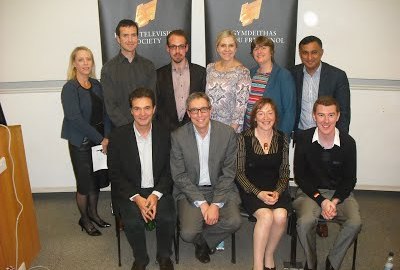
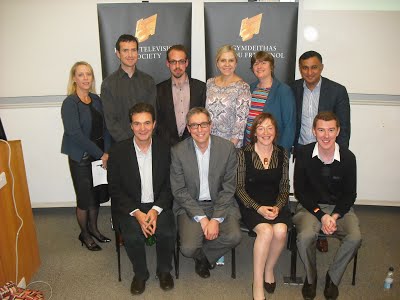
Dr Cindy Carter, Llion Iwan, Dr Ross Garner, Erika Hossington, Prof Jenny Kitzinger,
Ashok Ahir
Prof Justin Lewis, Mike Talbot, Angela Graham, Huw Foulkes
An enjoyable and thought-provoking event resulting in 3 on-going partnerships:
Prof Jenny Kitzinger and Erika Hossington: a potential new storyline involving coma next year for ‘Casualty’.
Dr Ross Garner and Mike Talbot: collaboration on producing tv in Wales for the mainstream.
Dr Cindy Carter and Huw Foulkes: collaboration on News for young teenagers.

“There are now plans to reflect adverts off the moon,” said Professor Justin Lewis as he argued that all television is ultimately driven by a  hidden consumerism. That was just one of the many insights gained as the Wales Centre paired academics with television professionals for one-to-one dialogue and debate at Cardiff University’s School of Journalism, Media and Cultural Studies.

Karin Wahl-Jorgensen reported that the BBC is still trapped in a two major party world when it comes to political reporting, while Jenny Kitzinger told us that the portrayal of people in a coma in hospital drama is not only wrong but actually misleads the public. Other subjects discussed included news provision for the younger teen audience and an attempt to define what the ‘mainstream’ means within commercial British television.

Mike Talbot from ITV Wales said that cage fighting and cuts to council services were both current and mainstream, but that only one was really popular with audiences. So which programme offered true public service broadcasting? As the academics would say – discuss!   Tim Hartley

  Ashok Ahir during the discussion

Expertise Exchange: Uniting Research and Practice for TV in Wales and beyond

Expertise Exchange: Uniting Research and Practice for TV in Wales and beyond is a joint RTS / Cardiff University School of Journalism (JOMEC) event.  See my blog post on the JOMEC website.

Contributors:

  • Professor Justin Lewis and Llion Iwan, Content Commissioner, Factual and Sport, S4C
    Consumerism, the hidden driver behind all TV production?
  • Professor Karin Wahl-Jorgensen and Ashok Ahir, of Communications Agency, mela; former Head of Politics, BBC Cymru Wales.  Impartiality and representation of opinion on TV news
  • Dr Cindy Carter and Huw Foulkes, Broadcast Journalist, Ffeil & Newyddion 9, BBC CymruWhat TV news provision does the younger teen audience want?
  • Dr Ross Garner and Mike Talbot, Series Editor, Wales This Week, ITV Wales
    Producing the ‘Mainstream’ in Wales
  • Professor Jenny Kitzinger and Erika Hossington, Series Producer, Casualty, BBC Cymru Wales
    How can TV drama represent family experiences of long term ‘coma’?

DSCF5997 (3)

An enjoyable and thought-provoking event resulting in 3 on-going partnerships:

  • Prof Jenny Kitzinger and Erika Hossington: a potential new storyline involving coma next year for ‘Casualty’.
  • Dr Ross Garner and Mike Talbot: collaboration on producing tv in Wales for the mainstream.
  • Dr Cindy Carter and Huw Foulkes: collaboration on News for young teenagers.

Continue reading Expertise Exchange: Uniting Research and Practice for TV in Wales and beyond