My consideration of Gwyneth Lewis’s collection of poetry, ‘Treiglo’ for the Cardiff Review. A first-rate book in content and also in design,achieving a striking coherence in all respects. Continue reading My review of ‘Treiglo’ for Cardiff Review
The Prorogation of Parliament
That day when the wedding guests exploded;
That day when I let a wee girl ricochet
From and towards her mother’s spew of blame;
That day I didn’t shelter
A railway worker from a racist shower …
Some close at hand, some far.
Kabul or Coleraine station, the same acid rain.
That day in Coleraine station when I witnessed
The airiness its architect enticed inside;
A guard whose smile kept all our doors ajar
And, in town, a window of bottles,
Wittily displayed — such light-filled things.
These close at hand. In far
Kabul or Coleraine station, the same inherent shine?
Today, when democracy exploded,
I was tread-milling for an email thrill
When I caught the acrid taste of tipping-point.
In the rank mulch of small misdeeds
The great ones grow. Wake up, wake up, my soul.
Some close at hand, some far.
Kabul, Coleraine, the Commons, I must reach those I can.
It was an inspiring theme from Matthew C. Smith, editor – the 50th anniversary of the Moon Landing to be dealt with in no more than 10 lines in an imagistic style. I wrote Moon, Landing from the perspective of the moon coming to earth rather than humans going to the moon. See Broadside 5. Black Bough Poems
Moon, Landing 20th July 1969
I was moon-hungry, ten years old,
So I set a mirror on the beach
And lay in wait that night.
Moon landed there, looked up
And was a child! Like me, an only child,
Tentative and curious, hoping to play.
To have him as my friend, I saw
I’d have to let him go
And come at will. Chastened, I prayed
That all the astronauts would lose their appetites.
On the same theme I also wrote a poem in Ulster Scots which will be in #9 of The Bangor Literary Journal, launching August 18th and First Death of The Troubles, occurred 14th July 1969 about the context of the Moon Mission in Northern Ireland – this is on my website.
I’m delighted to have a poem in Issue 9 of The Bangor Literary Journal, launching as part of the Open House Festival 1pm Sunday 18th August, Bangor. Especially pleased that the poem, Re-entry, Ulster is in Ulster Scots, inspired by the 50th anniversary of the Apollo Moon Landing.
https://www.openhousefestival.com/festival/
This is a week of momentous anniversaries, of the Moon Landing and also of a significant escalation of unrest in Northern Ireland, including two deaths in controversial circumstances.
The call-out for poetry for Issue 2 of Black Bough Poetry, for Imagist poems on the theme of the Apollo mission, prompted me to write three poems (one in Ulster Scots). One of these, ‘Moon, Landing’, is in the issue and another is here below. I wanted to consider the context in which I experienced the Moon Landing, and anniversaries which make us reflect on progress and also how we deal with memories, and with events, resolved or unresolved. Continue reading A Telling Week: 50 Years On
I am so thrilled that the poet, Glen Wilson has chosen to mentor me for a year. The aim is to compile a collection.
Glen’s collection An Experience on the Tongue has just come out from Doire Press. He won the Seamus Heaney Award for New Writing in 2017.
This amazingly generous initiative was sparked by Matthew C. Smith of Black Bough Poetry.

I’m particularly pleased that it is a poet from Northern Ireland and a poet from Wales who have been instrumental in giving me this wonderful gift as I have a project on Writing in Wales and Northern Ireland with the Centre for the Study of Media and Culture in Small Nations at the University of South Wales.
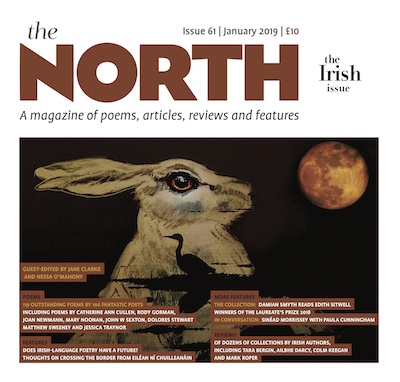
The Irish Literary Society hosted the London launch of issue 61 of The North magazine on February 25th. Published by The Poetry Business it is devoted to contemporary Irish poetry:
“119 poems by 106 fantastic poets”.
The Irish Literary Society is a child of the Irish Literary Revival of the late nineteenth century. Among its founders were WB Yeats and Douglas Hyde. Since 1892 it has championed and promoted Irish literature and facilitated discussion of and engagement with it. Continue reading The North at The Irish Literary Society
SHOOT
Winter came early for that girl
When the unreturning brother –
The endlessly prevented youth –
Was thrown first in a ditch
And then a grave.
She was the Winter’s girl,
Wearing its icy dress,
So when she saw one parent
Smash the other’s face into a wall
She wasn’t fazed. She understood how well
The rounded skull fits to the palm;
How deep the need to make pain visible since he
Had been hooded when they tortured him.
But she − to Mammy and Daddy both −
She had become
As faint as frost on glass.
Then even the mirrors emptied.
A neighbour, meaning to be kind,
Had asked her to help him set December bulbs,
Late possibilities. She’d cupped a Winter White,
A cranium, papery-skinned and primed,
But when his back was turned
She’d plunged the bulb in upside down,
Cursing it to torment itself
In growing towards the dark.
Since she was a murderer too
She sentenced herself to drink till she was sick
On school-nights out beyond the playing fields.
Thirteen,
And only the cold would do.
But a long dormancy
Can keep something alive.
Forty years on, even the Winter tired
Of cold. It dis-adopted her,
Heading for Spring
When she shouldered her dying mother
And felt how well that heavy head
Fitted the hollow below her collar-bone,
In that embrace sensing
A possibility, though late.
Image: Claire Loader
I’m honoured to have a poem in #61 of ‘The North’, the special issue on contemporary Irish poetry.
It launches on 24th January at Poetry Ireland, Dublin and on February 25th as an event organised by the Irish Literary Society.
http://www.poetrybusiness.co.uk/shop/993/north-61

I'm indulging myself by re-posting this poem of mine as it has Epiphany
allusions.
The wonderful image is of a capital in the Cathedral of Saint Lazare,
carved by Ghislebertus of Autun in the twelfth century: an angel awakens
the Magi.
CHRISTMAS STARS
The stars, a rowdy, cheerful crowd,
Ran to their places, prompt to the call,
And how they sing! since then,
A nightly choir.
Only the comets − their slow tears −
Betray the sorrow underneath that steadfastness,
For haven’t they seen it all?
− what we do down here,
Warping the darkness that they love
Into sly coverts for our filthiness.
Poor stars. Don’t grudge them their reprieve
Each year, when their paragon,
Their Star of stars, leader of kings,
Sets out once more and triumphs,
Finds his place, finding the child,
Perfect as every new-born.
Here! the Star declares to each of us,
Surely you see – surely – that you
Are a Child Awaited, you
Arrived − naked and loved − and you,
Gift-bearer of nothing,
Can stoop under this lintel,
Step clean through the needle’s eye.