All posts by angela

Crabb Deal on Broadcasting in Wales is not secure yet

See IWA Click on Wales blog page 9th March

Crabb Deal on Broadcasting in Wales is not secure yet

When Stephen Crabb, the Secretary of State for Wales, stood up on 27 February to proclaim a (fragile) cross-party consensus on further powers for Wales, he did so only hours after Ofcom, the media regulator, had closed its consultation on the future of public service broadcasting. Ofcom’s review and the Crabb ‘consensus’ represent potentially important milestones for broadcasting in Wales.

What the premature St. David’s Day agreement (a Sunday announcement was never on the cards) had to say about broadcasting, unsurprisingly, made no headlines, but it laid down an important marker for the coming debate on the BBC’s Charter and for the need to deepen Welsh involvement in media policy. There is a huge amount at stake both for viewers and for our television production industry.

Apparently, all four parties are now agreed on proposals that the IWA has supported and promoted for some years past in various publications, and in the evidence that it submitted to the Silk Commission by the UK’s Changing Union project in which it has been an active partner. It did so again last week in its response to Ofcom’s consultation document.

Mr. Crabb’s Command Paper says there was consensus around the following Silk Commission proposals: Continue reading Crabb Deal on Broadcasting in Wales is not secure yet →
ACS and DOCS – Academics and TV Documentary-making

ACADEMICS AND TV DOCUMENTARY-MAKING

 A WORKSHOP for CARDIFF UNIVERSITY GRADUATE COLLEGE

11TH    February

book-a-workshop-new

This is the fourth year I’ve presented this 3-hour workshop. I designed it as a contribution towards bridging the gap between the media and academia. I believe it still to be an unusual offer amongst university training because media training offered to academics is usually in the area of short-form and news-related input, not in long-form documentary. Between these two forms there are significant differences in working practice for journalists and, from the academics’ perspective, the skills needed to have a happy time as a contributor to a documentary are different to those that will produce a snappy sound-bite.

Academia and the media are two worlds which can intersect very fruitfully. However, when they don’t understand each other’s priorities and practices there are sometimes tears before bedtime.

The workshop is designed to examine key aspects of both worlds: what do they value? what do they want? what are they for? Where do these overlap and where must one recognise that they differ? Continue reading ACS and DOCS – Academics and TV Documentary-making →

DNA CYMRU series gets underway

8pm St David’s Day our new series on the history of Wales begins with an introductory programme. The series examines the potential of ancestral DNA to contribute towards the understanding of the past.

I have been very struck, while working on it, by a dual theme that emerges: Continuity  and Change. Humanity values both of these. Continuity promotes stability, the mastering of skills, the memorialising of the past so that it can feed the future. Change calls out new skills to integrate with established ones and it means encountering people and attitudes that challenge conclusions drawn from hard-won experience.

The material in the series has made me consider the relationship between the body and what we use the body to do; between ‘the givens’ of our lives – our physical inheritance – and the choices we make about our lives – our culture and our approach to life.

Continue reading DNA CYMRU series gets underway →

Industry Practitioners in Higher Education

Chapter 8 in ‘Cultural Work and Higher Education’

Edited by Daniel Ashton and Catriona Noonan (Palgrave Macmillan 2013)

I read this chapter on ‘cultural industries practitioners working within higher education’ with interest since I fit that category and have seen little written about this experience. The sample is rather small, drawing on interviews with 12 practitioners in three industry sectors at  five HE institutions, five of whom are Games Designers. However, there are references to various academic works on the topic. The key thing is that the role of industry practitioners is receiving some consideration. There are many nuggets of insight here. Continue reading Industry Practitioners in Higher Education →

Academics and TV Documentary-making

Cardiff University Graduate College:

Workshop Design and Delivery: Academics and TV Documentary-making  11th February 2015
 Feedback: from last year’s workshop:

  • Ø  Useful for anyone investing in the media side of research, also interesting just to see how research can be translated into TV
  • Ø  A really valuable workshop if you like to be engaged with media
  • Ø  A great opportunity to understand how academics can engage with TV documentary production
  • Ø  It teaches/introduces the basics of academic – TV partnership
  • Ø  Worth doing if you are interested in how your research can be used in TV
  • Ø  An excellent way to prepare yourself for making a documentary incorporating academic knowledge/sources

Cultural Work and Young Workers – Who cares?

On December 3rd the Cardiff Media Summit was held in the capital. This was an initiative of the Institute of Welsh Affairs, undertaken to promote collaborative reflection on the state of the broadcasting and media sector in Wales. It was jointly sponsored by BBC Wales and the University of South Wales. The latter had a stand near the entrance with books on display which had been written by university staff. I immediately found these titles of interest but, in fact, none were for sale on the spot yet what better buying public than scores of media professionals?

Continue reading Cultural Work and Young Workers – Who cares? →

All Things Considered: Annual Film Review

BBC Radio Wales Sunday 7th December

Unanimous praise for Calvary but disagreement over whether religion has ‘moved to the periphery of Irish life’

Fun being among the reviewers but I found myself at odds with them on this point.

Far from religion being on the side-lines, this film presents it as being so close to Irish hearts that its betrayal by clerical abuse of children results in a seething anger against clerics and the Catholic Church. Religion has failed but faith, in this film, is precious.

My favourite film, Bresson’s ‘Diary of a Country Priest’ is the model here. In both films a good priest is surrounded by embittered, suffering parishioners who taunt and confront him with the monstrosity and absurdity of suffering. There is plenty of jeopardy of the usual who-dunnit type but even more hangs on the risk that the priest will compromise his principles from sheer fellow-feeling.

A key role is that of the newly bereaved French wife whose clear-eyed acceptance of enormous loss proves a touchstone. Integrity, the coherence between what a person believes and what he or she does, is a major theme.

A great cast. Brendan Gleeson and his son, Domhnall are powerful in one of the many one-to-one encounters.

Why do we get angry at suffering as though it is something unexpected? That’s a question I feel this film put in front of me.

iPlayer Radio: http://www.bbc.co.uk/programmes/b04snkt6


The Writers’ Guild


Executive Committee Member, Wales
Organiser, The Media and Devolution – what do we need to know?
18th September 2013 Chapter Arts Centre
The Pros and Cons of Devolving Control of the Media to Wales – Speaker: Aled Eirug.
A  Guild Members Only event.
Facilitator of the submission from the Guild in Wales to the Commission on Devolution in Wales (Silk) September 2013
Union Learning Adviser for The Writers’ Guild 2009 – 2014
Identifying and responding to members’ training and development needs. ULA information

Of Mourning and Memory

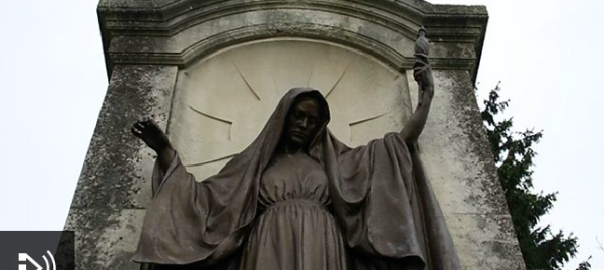
Listen Online I devised and presented this documentary on First World War Memorials in Wales

Wales Remembers / Cymru’n Cofio  

p02b7wxl
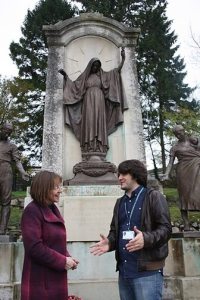
Angela Graham and Chris Parry at the Pontmorlais First World War Memorial.

BBC Radio Wales,  Sun 9 Nov 2014 10:30

With Contributions from:

  • Prof. Jay Winter, Yale University.
  • Dr. Lester Mason, University of Wales Trinity St David.
  • Prof. David Machin, Orebro University, Sweden.
  • Prof. Sir Deian Hopkin, Adviser to First Minister on Commemoration of WW1.
  • Michelle Darby, Grangetown Local History Society.
  • Chris Parry, Communities Officer, Cyfarthfa Castle Museum and Art Gallery.

Expertise Exchange

Initiator and Organiser:   24th October 2013

                                                                 a joint RTS / Cardiff University School of Journalism (JOMEC) event 
                                                                                                                                                                                   
Contributors:
  • Professor Justin Lewis and Llion Iwan, Content Commissioner, Factual and Sport, S4C
    Consumerism, the hidden driver behind all TV production?
  • Professor Karin Wahl-Jorgensen and Ashok Ahir, of Communications Agency, mela; former Head of Politics, BBC Cymru Wales
    Impartiality and representation of opinion on TV news
  • Dr Cindy Carter and Huw Foulkes, Broadcast Journalist, Ffeil & Newyddion 9, BBC Cymru
    What TV news provision does the younger teen audience want?
  • Dr Ross Garner and Mike Talbot, Series Editor, Wales This Week, ITV Wales
    Producing the ‘Mainstream’ in Wales
  • Professor Jenny Kitzinger and Erika Hossington, Series Producer, Casualty, BBC Cymru Wales
    How can TV drama represent family experiences of long term ‘coma’?


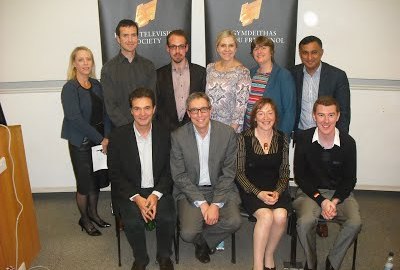
Dr Cindy Carter, Llion Iwan, Dr Ross Garner, Erika Hossington, Prof Jenny Kitzinger,
Ashok Ahir
Prof Justin Lewis, Mike Talbot, Angela Graham, Huw Foulkes
An enjoyable and thought-provoking event resulting in 3 on-going partnerships:
Prof Jenny Kitzinger and Erika Hossington: a potential new storyline involving coma next year for ‘Casualty’.
Dr Ross Garner and Mike Talbot: collaboration on producing tv in Wales for the mainstream.
Dr Cindy Carter and Huw Foulkes: collaboration on News for young teenagers.

“There are now plans to reflect adverts off the moon,” said Professor Justin Lewis as he argued that all television is ultimately driven by a  hidden consumerism. That was just one of the many insights gained as the Wales Centre paired academics with television professionals for one-to-one dialogue and debate at Cardiff University’s School of Journalism, Media and Cultural Studies.

Karin Wahl-Jorgensen reported that the BBC is still trapped in a two major party world when it comes to political reporting, while Jenny Kitzinger told us that the portrayal of people in a coma in hospital drama is not only wrong but actually misleads the public. Other subjects discussed included news provision for the younger teen audience and an attempt to define what the ‘mainstream’ means within commercial British television.

Mike Talbot from ITV Wales said that cage fighting and cuts to council services were both current and mainstream, but that only one was really popular with audiences. So which programme offered true public service broadcasting? As the academics would say – discuss!   Tim Hartley

  Ashok Ahir during the discussion